![]()
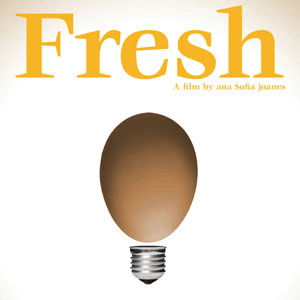
Last week I saw a screening of a Fresh, new documentary by Ana Sofia Joanes. If you follow Michael Pollan the way I do, you already know most of the issues covered, but it’s nice to hear about it from the people actually involved.
The subject is the way food is produced in the U.S., from “conventional” agriculture — meaning large-scale industrial monoculture operations — to more traditional mixed-use farming, to urban gardens in greenhouses on what used to be vacant lots.
Independence = happiness
There is no narration, so the story is entirely left to the farmers being interviewed. But one unavoidable conclusion is that the people using conventional techniques feel trapped by the system, with little control over their lives.
One couple owns a chicken farm. They never name the company they sell the chickens to, except to call them “the company”. What they do say is that they had to sign a 7-year contract stating that they will:
- buy all chicks from the company
- buy all feed from the company
- sell all full-grown chickens to the company
- maintain their own facilities at their cost while making upgrades as demanded by the company
And their profit is based on how many pounds of feed it takes to grow each chicken to four pounds. If they didn’t agree to the terms, the next day they would have no new chicks, and there are no other suppliers available in their area. Industrial agriculture has been increasing scale, specialization and concentration for decades, and has now reached the point that two or three companies can dictate terms of the entire process, “from seed to plate” as Pollan says.
As you watch this couple, you’ll notice the wife does most of the talking. And the husband seems to look more and more unhappy, as though he’s just realizing, as he hears his wife spell it out, how little control they have over their own success.
In contrast, the farmers who have opted out of the industrial process are universally happy with their lives. They love what they do, and look forward to sharing what they produce.
One hog farmer recounts getting scratched by a tusk when he was running a confinement-style operation. After three weeks, he nearly lost his leg to the antibiotic-resistant staff infection he contracted. Only a new, experimental drug worked. He finally listened to the voice in the back of his head that had been telling him this wasn’t the right way to do things.
He slaughtered his entire herd and started over from scratch, without using antibiotics. And because he doesn’t confine the hogs in close quarters, he doesn’t have the disease problems that would require them.
It’s not all about the bottom line
The startling thing, if you haven’t heard it before, is that the mixed-use operations actually yield many times as much money per acre as the monoculture operations. Why, then, do companies keep moving in that direction? Don’t corporations always follow the bottom line?
In this case, it’s a matter of control. The goal of industrialization has always been consistency. And the surest way to eliminate variability is to eliminate people from the process as much as possible. Financial projections work better when you can specify what your inputs will be, and you know the yield, so you can calculate the output precisely.
Traditional farming requires a knowledgeable farmer, which we used to have and value in this country. Instead, industry prefers “workers” who can follow directions.
So why do we eat it?
The food coming out of industrial agriculture isn’t as tasty, isn’t as nutritious, and even frequently costs more than cooking from scratch. So why do we eat it?
That’s answered in the first five minutes of the movie, when a farmer tells about his college roommate who came from Pakistan. He said that Americans are only terrified of one thing: Inconvenience.

Want more like this? For more recipes like this, that you can hold right in your hands, and write on, take notes, tear pages out if you want (Gosh, you're tough on books, aren't you?) you might be interested in How To Cook Like Your Grandmother, 2nd edition, Illustrated. Or to learn your way around the kitchen, check out Starting From Scratch: The Owner's Manual for Your Kitchen.


11 Comments
Thanks for talking about this very important topic, and this movie. You are right, we small farmers love what we do. Big Food really frightened people into believing that the industrial way is the only way. We farm for ourselves using natural methods and old school ways.
The latest round of food recalls should serve an encouragement for everyone to make their own food – not only make it.. but MAKE it – grow it yourself. Its just not that inconvenient. Grow what you eat, eat what your grow, and do it in a sustainable way.
Thanks Drew!
Amy, I mostly agree, but wouldn’t go as far as saying everyone should grow all their own food. Tending livestock is a full-time gig. If we all grew our own, we’d all be farmers. Besides, I live in the suburbs. No place to grow a steak around here.
But I do think we need a lot more farmers — and a lot more farms — than we have now. And they need to be spread out around the country, so all our food isn’t spending three days on trucks before it gets to us.
I’ll grow my own veggies and herbs, but I need a good rancher nearby.
Thanks for the very timely and import post! I knew this stuff already (lucky for me)
and do agree that the general population “wants convenience” but they absolutely DO NOT know what is in all that manufactured food. I’ve spent the last year learning and I’m sure I’ve loads more to learn. Where I live (small Texas community), there is no true community vegetable market available and since I’ve tried (mostly in vain) to grow my own veggies, I now understand. It’s just too dang hot here to grow anything here (even a tomato and believe it or not Okra). I buy organic veggies from the supermarket, but after all I’ve read, how am I to know its really organic (by looks?) since the Govt labels don’t really mean that much and even the organic farms are being taken over by “corporations” since they see the money in it now. What a mess we’ve made by our ignorance, huh?
It’s not just us who don’t know. They asked the chicken farmers what was in the feed, and they had no idea.
On a completely different subject. You mentioned you had a poll you were taking on how much direction we in the email community wanted with your very very good recipes. Well, I couldn’t find the poll location at your website to here’s my answer:
Lots of directions please or as many as you usually do in unshortened recipes.
PS…just love your web postings/email recipes. I’m so glad I found this website!
Oh come on Drew, wouldn’t you just love to see your neighbor’s face if you had a big ol’ beef cow in your yard?!


I think more people are taking an interest – back yard chicken keeping is really booming right now. And there is tons of info on ‘micro-farming’ in city. Until then, we’ll keep the small farms going if you keep encouraging folks to eat local.
I have been looking for ways to make our small farm work, but it’s a messed up economy right now. People are hurting for money, and buying fresh off the farm is expensive compared to the factory farmed stuff. If I raise meat birds, they will cost more to raise, and a couple bucks a bird to process if I have someone else do it, coming out to a sale price of around $10 a bird. Some people will pay that, but most people can’t afford to when there are whole chickens for sale at the market for $3 a bird.
I have been told that the heritage breeds taste better than the frankenstein-chickens that are commercially raised for meat. Factory birds are bred to grow to full size in 8 weeks, which huge breasts to provide lots of white meat. Heritage chickens take 20 weeks to grow to size, and the breasts are skimpier. This year I’m raising some specifically to eat, and we’ll see how it goes. If they really are a superior product, then I guess we’ll see if people are willing to pay the extra cost of growing them out longer.
Likewise we have been looking at Icelandic sheep. They are supposed to provide wool, sheepskin, and superior meat, lightly grained and low in fat. Lamb is a great meat, and the animals make a much lower impact on a small farm than cattle.
I was disturbed to buy some ground beef at the supermarket the other day and see it labeled as a product of USA, Canada, Australia, and New Zealand! All four, or just one and they don’t know which?
This year we will be raising our veg and chickens, buying what we can’t raise from local growers, and looking for gaps in the local market that we might be able to fill ourselves. It seems like a shame to have a small acreage and not be able to do anything productive with it.
I won’t guarantee it, but it’s very likely it was from all four. They buy different cuts and different scraps from different suppliers, and mix it all together to get the exact right percentage of fat in it.
Excellent review. There have been so many of these type of films lately, but I love the fact that they are encouraging consumers to think harder about what they buy. As Michael Chiarello says: “we vote with our forks.”
Has this film been released yet? I’d like to see it.
I live in Portland, OR, and urban farming is a BIG deal here. I have a friend who grows most of her own vegetables and herbs, and raises chickens, in her backyard. Since she is vegetarian, that means that a lot of what she eats was either grown by her, or by someone local. I live in an apartment, and my husband and I have just planted some herbs and veggies in containers on our balcony. We look forward to the day when we have a house of our own and can start farming in our backyard as well.
Stephanie, it’s not in wide release, but if you check the website, they list where there will be screenings, and also have directions for how to set up a screening of your own.