For special deals and more great content, sign up for the free How To Cook Like Your Grandmother Newsletter.
Email address:


Also receive blog posts via email

Name: (optional)

Not now, thanks

How To Make Tortilla Chips

I love going to Mexican restaurants. All the ones around here have fresh chips and salsa on the table as soon as you sit down. I’ve occasionally had some sub-par salsa, but the hot, fresh chips are always totally addictive.

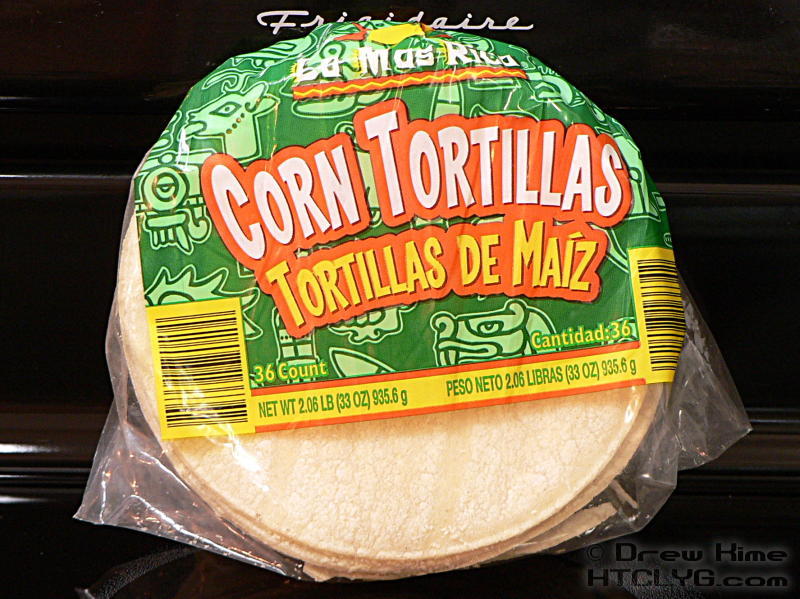
I’m not quite ready to make my own tortillas, but with a pack of 50 pre-made corn tortillas costing about a dollar — and the ingredients looking about like what I’d use myself — I’m okay with buying them for now.

And the chips … oh, man, the chips are good.

Ingredients

corn tortillas
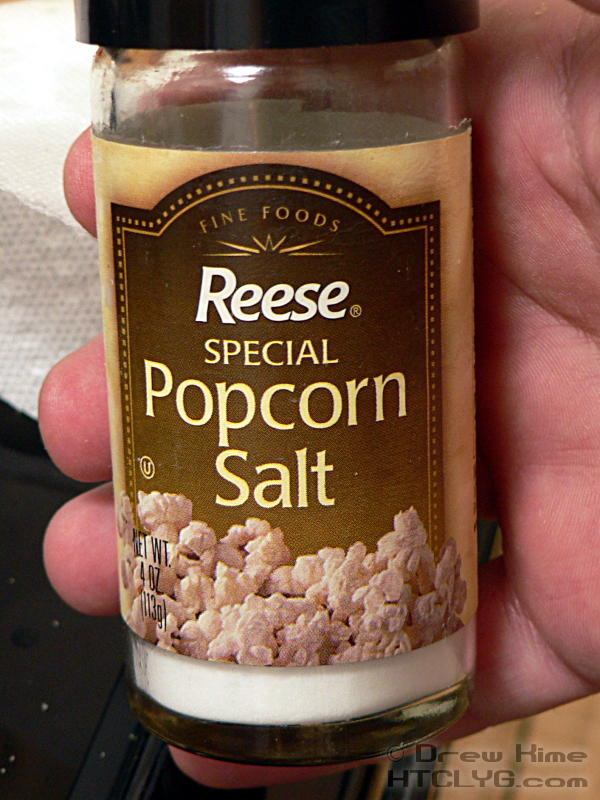
popcorn salt (see note below)
fat / oil for frying (I used olive pomace, see other note below)

Directions

I’ll just do the recipe real quick, then have the notes about ingredients at the end.

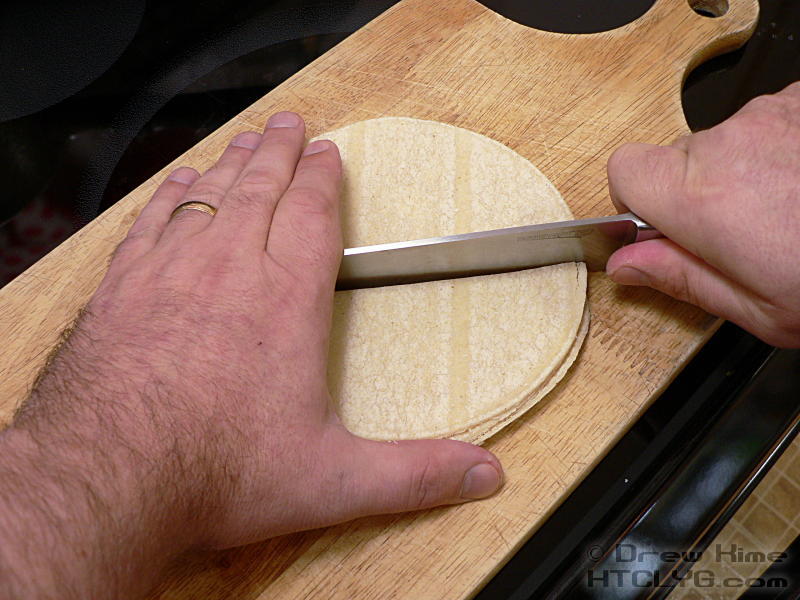
Cut the tortillas into six even pieces. I stacked up five of them and did them all together.
Pre-heat your fat / oil almost to its smoke point. (Notes below.) I used a very small pot, so I wouldn’t need as much oil. And the tortillas float, so you don’t need it to be very deep.

Carefully place three or four chips in the oil. You don’t want them to overlap, but they don’t need a bunch of space between them.
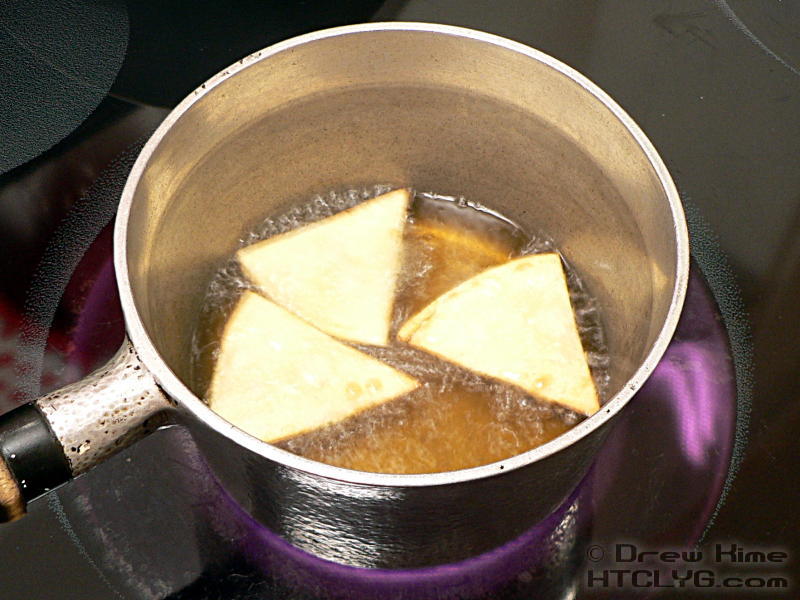
When you see the edges starting to get dark, or the chip starts puffing up with bubbles, turn them over.
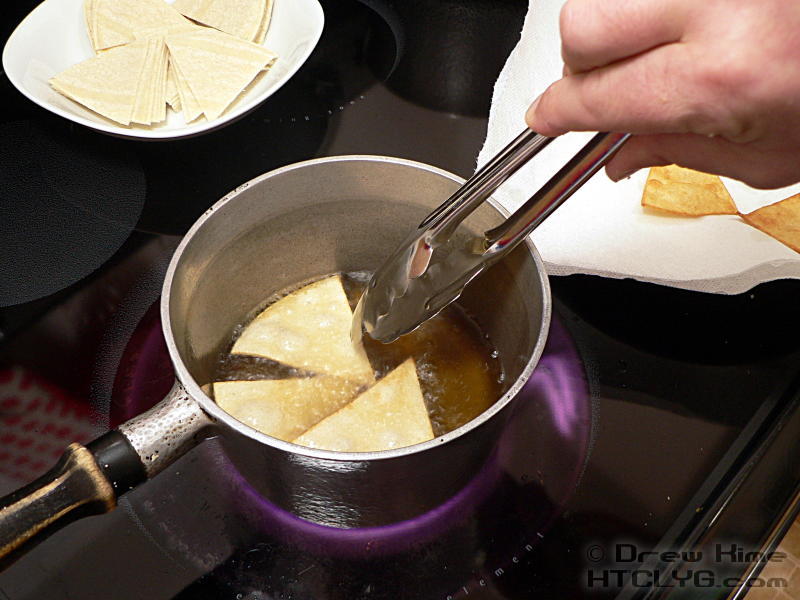
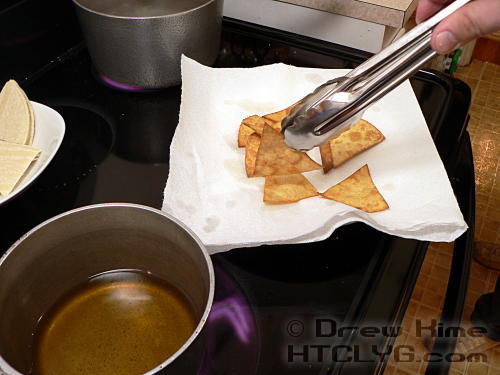
Cook on the other side until lightly browned. Mine only took about 20-30 seconds per side. Remove to a plate lined with paper towels, letting excess oil drip back into the pot first.
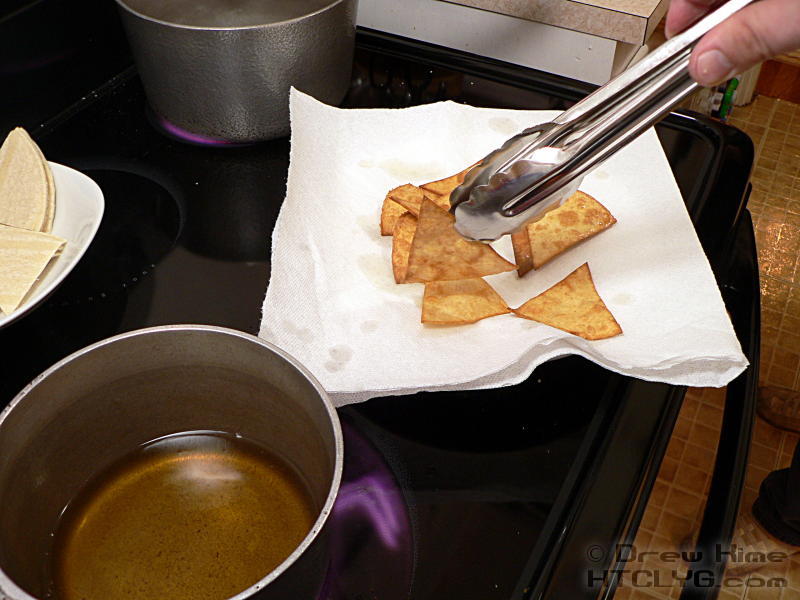
Sprinkle with popcorn salt, and that’s it.

Notes on ingredients

First, the popcorn salt. If you’ve never seen it, it’s plain old table salt, but ground finer, almost like powdered sugar. The smaller grains stick to food better, so the salt doesn’t all end up in the bottom of the bowl. Useful for any salty snacks, except pretzels.

You’re more likely to find it in the popcorn aisle than the baking aisle. (And for anyone reading this from outside the U.S., yes, we actually have a popcorn aisle. I’ve lived here my whole life and it still blows my mind every time I see it.)

Frying in fat vs. frying in oil

Now what should you fry in? (If you aren’t interested in the political history, just go check out Andrew’s cooking oil comparison chart to get the smoke point for your choice. Cook just below that temperature.)

Once upon a time Mexican cooking relied on lard — pork fat — both as an ingredient and for frying. (It was also used around the world in pastries, like pie crusts. But I’m talking about frying here.) And American fast food places relied on tallow — beef fat — for frying french fries and … well, everything else that was deep fried.

The case against fat

But some research seemed to show that eating saturated fat — mostly what you get in animal fats — is bad for you. This research wasn’t actually very good, but it was promoted heavily by companies that grew corn and soybeans. And wouldn’t you know, vegetable oils don’t have saturated fat.

More and more people are starting to question this “conventional wisdom” that animal fat is bad for you — wisdom that’s only been conventional for about 100 out of 40,000 years of modern human existence. If you think back to when you first heard the term “trans fat” you’ll understand how recently it broke into mainstream consciousness that maybe eating a lot of shortening (AKA partially hydrogenated vegetable oil) isn’t such a great idea after all.

But wait, there’s more. Not only was there a health-based movement against animal fats, there was also a strong economic driver in favor of more corn oil.

The beginning of corn subsidies

In the 1960s, rising food prices became a national political issue. President Nixon told Secretary of Agriculture Earl Butz to do whatever it took to bring down prices.

Butz told farmers to “get big or get out,” and to plant commodity crops like corn “from fencerow to fencerow.” This wasn’t merely a suggestion. He also reversed farm policy to make it happen.

After the dust bowl in the beginning of the 20th Century, policies had been put in place to suppress overproduction.

The program that Butz inherited worked like this: When farmers began to produce too much and prices began to fall, the government would pay farmers to leave some land fallow, with the goal of pushing prices up the following season. When prices threatened to go too high, the payments would end and the land would go back into cultivation.

The government would also buy excess grain from farmers and store it. In lean years — say, when drought struck — the government would release some of that stored grain, mitigating sudden price hikes. The overall goal was to stop prices from falling too low (hurting farmers) or jumping too high (squeezing consumers).

Butz reversed this policy, instead seeking to maximize productivity at all costs.

Rather than keep a floor under prices for farm goods, the USDA would now lavish farmers with direct payments. That meant that if the market price for a good fell under farmers’ production costs, a government check to the farmer would make up the difference. This policy switch marks the birth of the subsidy system that remains controversial today.

That means every bushel of corn and soybeans sold in the U.S. is federally subsidized. The more of it farmers grow, the more they make. Laws of supply and demand have been suspended.

What that means is there’s so much of the stuff on the market, they needed to find new ways to use it. First they invented corn syrup. And got congress to pass a tariff on foreign sugar, making corn syrup the cheaper choice. (That’s why Mexican Coca Cola is still made with cane sugar, and people smuggle it into the U.S.)

Then they figured out how to get cattle to tolerate it long enough to get to slaughter. (Cows and other ruminants are designed to live on grass.) It involves turning the corn into flakes, then frosting those flakes with tons of antibiotics:

Every year in the United States 25 million pounds of valuable antibiotics — roughly 70 percent of total US antibiotic production — are fed to chickens, pigs, and cows for nontherapeutic purposes like growth promotion, according to a new report from the Union of Concerned Scientists.

That led to CAFOs — Concentrated Animal Feeding Operations. It’s interesting to note that the government entity that defines “CAFO” is the EPA. (Check that last link again.) And that when you search Google for government sites that answer the question what is a CAFO the first two links are CDC and EPA (Center for Disease Control and Environmental Protection Agency).

But this wasn’t supposed to be about beef, I was talking about frying chips.

The point is, most restaurants and processed food manufacturers have switched to vegetable oils. They’re responding to consumer demand (based on bad science pushed by vegetable oil manufacturers), and to lower prices (based on federal subsidies). When you are cooking for yourself, you can ignore the bogus health claims; and you’ll end up spending less than buying the prepared foods anyway, so you might as well spend a little more for a better oil.

What you should fry in

For ethnic authenticity, you should fry tortilla chips in lard. If you’re going to be doing a lot of them, and you want the fat to last longer, go with tallow.

But if you don’t have one of those, or if you really don’t want to use animal fats, you can get olive pomace oil. It has the same health profile as extra virgin olive oil, but without the flavor and with a higher smoke point.

If you go searching online for information about pomace, you’ll find plenty of people saying it is a highly processed food and shouldn’t be eaten. You’ll also notice that many of those people work for — or are accredited by — trade groups promoting extra virgin olive oil. That doesn’t mean they are necessarily being dishonest, but take what they say with a grain of salt.

Also, keep in mind if you buy processed foods advertised as being made with olive oil, it’s most likely pomace that they used. So you probably already eat it.

One more good option is peanut oil. For people who understand why vegetable oils are not suitable for deep frying, this is the preferred choice for deep fried turkey. (Which, by the way, I’m trying to get some neighbors together for this fall.) It’s got a high smoke point and a light flavor.

All that for some chips?

No, of course not. After all, I had to put something on the chips, didn’t I? I’ll be getting to that by Friday, but first I’ll be showing you the cool new gadget I got after seeing it demoed in New York.

Want more like this? For more recipes like this, that you can hold right in your hands, and write on, take notes, tear pages out if you want (Gosh, you're tough on books, aren't you?) you might be interested in How To Cook Like Your Grandmother, 2nd edition, Illustrated. Or to learn your way around the kitchen, check out Starting From Scratch: The Owner's Manual for Your Kitchen.

This entry was posted in Side and tagged , . Bookmark the permalink. Post a comment or leave a trackback: Trackback URL.

18 Comments

  1. Cerise
    Posted October 12, 2009 at 11:39 pm | Permalink

    We have so many Mexican eateries here in Houston. It like having a church on every corner. They call themselves Mexican, but it really is Tex-Mex which I can not stand. I like tortilla chips as much as the next next guy, but homemade is much better. Just make sure you start out with a decent tortilla.

  2. Kristin @ Going Country
    Posted October 13, 2009 at 6:58 am | Permalink

    Huh. Our popcorn shares an aisle with candy and water and nuts and juice. It doesn't get its own aisle. Maybe you take popcorn more seriously in the midwest.

  3. Kate in Italy
    Posted October 13, 2009 at 11:11 am | Permalink

    I've had to learn how to make my own tortillas because Mexican food is rare if it exists at all, here. I've found that they're not as hard as you might think and they taste better. The wonky home-made look is also nice. Now I know what to do with the leftovers of a big batch! What cheeses do you think would be good for nachos? Cheddar isn't accepted nor supported here, Italians think its the ugly-redheaded-step-child of real cheese.

  4. Posted October 13, 2009 at 11:30 am | Permalink

    Cerise, I'm in Cleveland. If it's got either refried beans or tortillas in any shape, it's called "Mexican". We don't get to debate whether it's "real" Mexican or really Tex-Mex.

    Kristin, our regular grocery store has it with the chips. The Costco has such a ridiculous supply of popcorn that you can smell the "butter flavor" whatever-it-is from two aisles over.

    Kate, by the end of this week you'll see these topped with Meunster and a few other things you don't usually see on nachos.

  5. Keep_It_Simple_Engineer
    Posted October 13, 2009 at 12:03 pm | Permalink

    Some more about popcorn salt…

    It is generally not iodized like table salt (check the label).

    Because it is a finer grain, it will taste saltier for the same amount as table salt—and therefore is sometimes recommended to people restricting their salt intake.

    Really good for use in salads!

  6. Amy
    Posted October 13, 2009 at 12:34 pm | Permalink

    I like to get my kids in on the fun, so I have them stack up some tortillas and cut them with the pizza cutter….

    D'you think I could just whiz some regular salt thru the food processor? works for sugar, but hmmm…

  7. Posted October 13, 2009 at 12:35 pm | Permalink

    I'm sure that's true, but there's also another issue if you're measuring it out: Finer grains will pack together more tightly, so one teaspoon of popcorn salt will probably be heavier than one teaspoon of table salt.

    This is an issue when canning, because you can be using several cups of salt. A finer grind than the recipe was designed for can mean quite a bit more than intended.

  8. Posted October 13, 2009 at 12:49 pm | Permalink

    Whoops, that comment was for the engineer.

    So Amy, you powder your own sugar? I guess if you run out halfway through baking, it's nice to have a backup. For the salt, though, if you're only doing enough for one recipe I think you'd end up with more of it stuck to the inside of the processor than you get in the food. I might give that a shot, though, just to see what happens.

  9. Keep_It_Simple_Engineer
    Posted October 13, 2009 at 2:23 pm | Permalink

    About measuring salt…

    Fine grain (popcorn) salt's difference comes when eaten "directly", as in from a shaker. So when adding as a cooking ingredient, the popcorn and table salt are pretty much the same.

    From experience baking, I always measure by weight. I also use kosher salt for purity (to avoid surprises).

    One tablespoon (leveled by a spatula) of:
    Morton's Table Salt 19.8 grams
    Morton's Popcorn Salt 19.2 grams
    Diamond Crystal Cooking Salt 21.6 grams
    Diamond Crystal Kosher Salt 10.0 grams

    The Morton's Table Salt was Food Service, meaning it was not iodized—and may be slightly different that regular table salt.

  10. Posted October 13, 2009 at 3:10 pm | Permalink

    Wow, those numbers are surprising. I knew the kosher would come out lighter, but I didn't expect half. And popcorn salt was not the heaviest? That's also a bit surprising. Apparently even with the finer grains it doesn't compress as much as I would have expected.

    Just goes to show, in any conflict between theory and reality, reality always wins.

  11. Keep_It_Simple_Engineer
    Posted October 13, 2009 at 3:55 pm | Permalink

    I too was surprized.

    I actually measured the Kosher salt twice (just to be Kosher, so to speak).

    I suspect it has more to do with grain shape and uniformity. The packing density of spheres doesn't change for different sphere diameters. That is, a gallon jar of big marbles will weigh the same as a gallon jar of small ones.

    Thanks for letting a retired engineer weigh in.

  12. Posted October 13, 2009 at 4:30 pm | Permalink

    Really? (Re: The sphere packing.) That is so unintuitive. I'm sure there's a mathematical proof of it, but … well, wait. The smaller ones will fill in all the way to the corner, but there will be all the voids through the middle.

    Huh. Learned something new today.

  13. Keep_It_Simple_Engineer
    Posted October 14, 2009 at 1:56 am | Permalink

    Hard to understand the mathematician's fascination with spheres.

    Sir Walter Raleigh asked them to determine the best way to stack cannonballs on ship decks.

    Famed astronomer-math guy Johannes Kepler in 1611 conjectured that the pyramid is the best way to stack cannonballs.

    Thomas Hales (U of Pittsburgh math guy) & Samuel Ferguson (math guy at the National Security Agency) proved it in 1998 and had their proof verified in 2007.

    The proof is about 300 pages long—not counting 40,000 lines of computerese and 3 billion characters of data.

    Everybody needs a hobby, I prefer cooking. Thanks for Drew for making it fun & easy.

  14. Bookmom
    Posted October 23, 2009 at 3:23 pm | Permalink

    New reader here. It was this post that made me decide to add your blog to my Google Reader page. Love this brief history of the degradation of modern agriculture, as well as the previous one about why we can't really cook like our grandmothers!

    Just one thing: the smearing of animal and saturated fats has only been going on since the late 60's, so only about 40 years, not 100. It was based on the media hyping a poorly-done and poorly-understood study. At the time people thought animal fat was good for you, so that gave the story wings and made it sensational because it really flew in the face of both science and conventional wisdom. That was the start of the whole low-fat fad, too. Same history: a fad because it's only been about 40 years out of the whole flow of human history.

  15. Posted October 23, 2009 at 5:14 pm | Permalink

    Bookmom, I hope you'll forgive me for pointing out that I don't have any first-hand recollections of what was happening 40 years ago. I was basing those dates on when margarine was introduced. That's how long someone has been trying to sell us corn oil as a substitute for butter. I guess the 60s is when it really took off.

  16. Bookmom
    Posted October 23, 2009 at 6:17 pm | Permalink

    Hi Drew,

    Well, I was about two when the study came out, but it's well-known. The Weston A. Price foundation talks about it in several articles; Dr. Atkins also talked about it. I was mistaken: it was in the late 50's, and the researcher's name was Ancel Keys. http://www.westonaprice.org/knowyourfats/skinny.html

    My mom has told me that until WW2 and rationing started, no one wanted margarine if they could afford butter. Napoleon offered incentives for the invention of a butter substitute which could be used by soldiers and the lower classes, and that's pretty much what it was for a long time. http://ww.westonaprice.org/bookreviews/what-to-eat.html

  17. Posted October 23, 2009 at 7:58 pm | Permalink

    Okay, right, the Keys study. I've read a bunch of stuff from WAPF, so I'm familiar with that one.

    I grew up with margarine, and while I can't really remember talking about it, I have a vague memory that my parents' generation "knew" that it was better for them.

    This actually makes it an even more remarkable story, though. That we've so completely reversed the "conventional wisdom" twice in three generations. That's simply amazing.

  18. Bookmom
    Posted October 24, 2009 at 8:32 am | Permalink

    I thought it sounded like you know your Price!

    And I'm actually a decade younger than that, but I can remember all the commercials in the 70's with Florence Henderson extolling Wesson Oil, and how it seemed like something pure white and scentless like Crisco just had to be good for you. Maybe it's just that I was a kid and wasn't paying attention earlier, but it seems like the really widespread outcry about butter started in the late 70's/early 80's. I mean, that's when the evening news and mianstream women's magazines really started talking about it more, rather than just the professional publications and granola magazines.

» Subscribe to comments on this post

Post a Comment

Your email is never published nor shared. Required fields are marked *

*
*

You may use these HTML tags and attributes: <a href="" title=""> <abbr title=""> <acronym title=""> <b> <blockquote cite=""> <cite> <code> <del datetime=""> <em> <i> <q cite=""> <strike> <strong>

  • Free Online Class

    Sign up now for my free 10-day online course in the basics: Starting From Scratch

  • Buy the Book


    Cooking used to be all about making food that tasted good. But somewhere along the way, we seem to have decided the diet-of-the-week was more important. How to Cook Like Your Grandmother is a return to recipes and techniques that are based on what tastes good, not on junk science and fad diets. You won't find the words lite, low, lean, free or skim anywhere. This is all real food, cooked the way Grandma would have done it.
  • Buy the Other Book


    People have been making and eating food as long as there have been people. And food. But somehow we've let ourselves believe that it's something only experts can do "right". That's where Starting From Scratch comes in. I'm not saying you'll go from zero to hero just by reading it, but at least now you'll know what those self-proclaimed experts are talking about.
  • Follow this blog

     Subscribe in a reader

    -- OR --
    To get recipes in your email
    Enter your email address:
    -- OR --
    Sign up for the weekly newsletter. Email address:
  • All-time Favorites

    Perfect Brownies French Onion Soup Bruschetta Pizza Egg Salad Onion Rings Banana Cake Cheesesteak Peach Cobbler Frozen Chocolate Truffle Pie Emily's Creamy Cheesecake
  • No Awards Please

Page optimized by WP Minify WordPress Plugin