For special deals and more great content, sign up for the free How To Cook Like Your Grandmother Newsletter.
Email address:


Also receive blog posts via email

Name: (optional)

Not now, thanks

How To Make Cultured Butter (and Buttermilk)

Why on earth would you make your own butter? The stuff at the grocery store is already made from nothing but cream, isn’t it? Okay, and salt if you buy salted butter. But that’s pretty good isn’t it?

Because this butter is better. You read that right: better than ordinary butter. Hard to believe, but there you have it.

Okay, it’s not so much better that I won’t use store-bought butter in my cooking and baking. But when I want something to spread on crusty French bread, or on top of warm coffee cake fresh from the oven, I want the best butter you can get. And as of today, this is it.

Ingredients


1 quart heavy cream
1/3 cup plain whole-milk yogurt

Directions

Like all my favorite recipes, this one doesn’t have a lot of ingredients. And it’s not terribly sensitive to amounts, so next time I won’t even bother dirtying a measuring cup. I’m lazy that way.

What does make a difference is getting good ingredients. Make sure the cream doesn’t have stabilizers or additives. The ingredients should look like this.

Same for the yogurt. My grocery store has a yogurt section that’s about 40 feet long, floor to ceiling. And only one plain, whole milk selection in the lot.

Pour the cream into a spotlessly clean glass or earthenware bowl. Plastic can hide bacteria in any surface imperfections. After you pour, open the box up and see if you’ve got a bunch of milk solids left, and scrape it all into the bowl.

Add a third of a cup of yogurt.
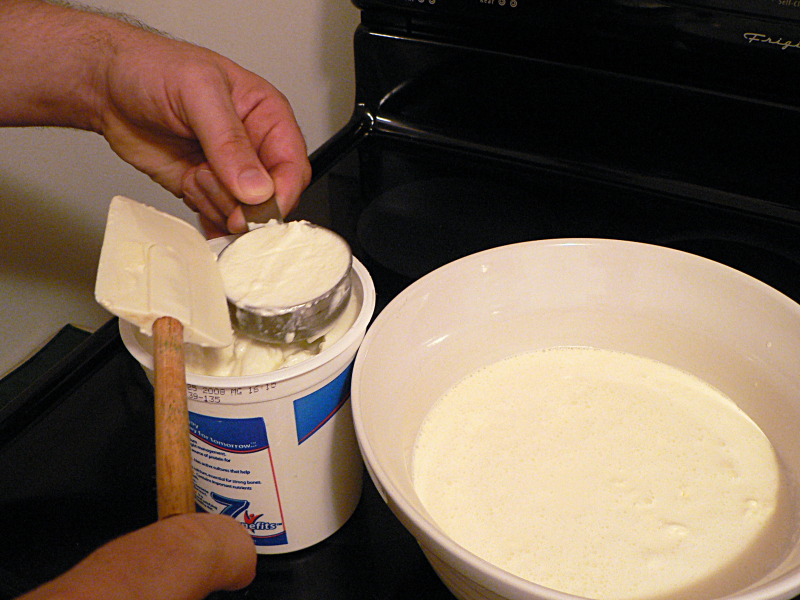
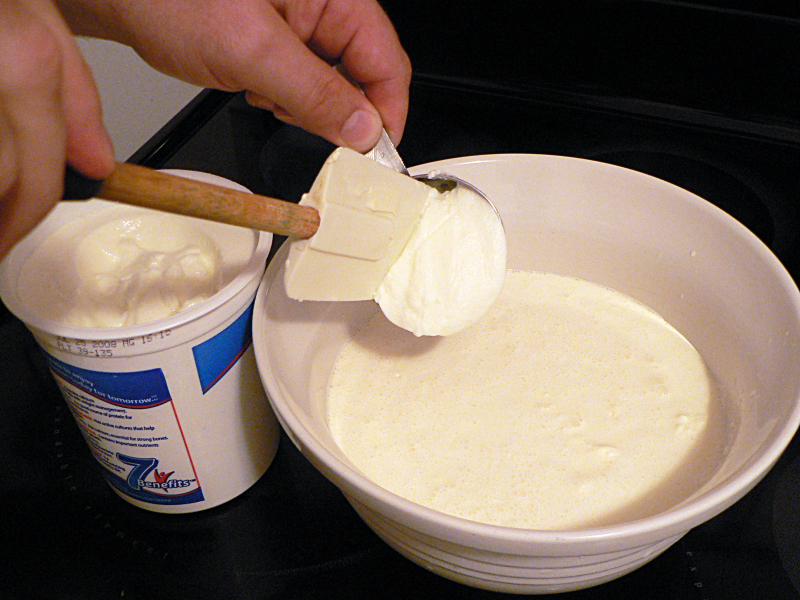
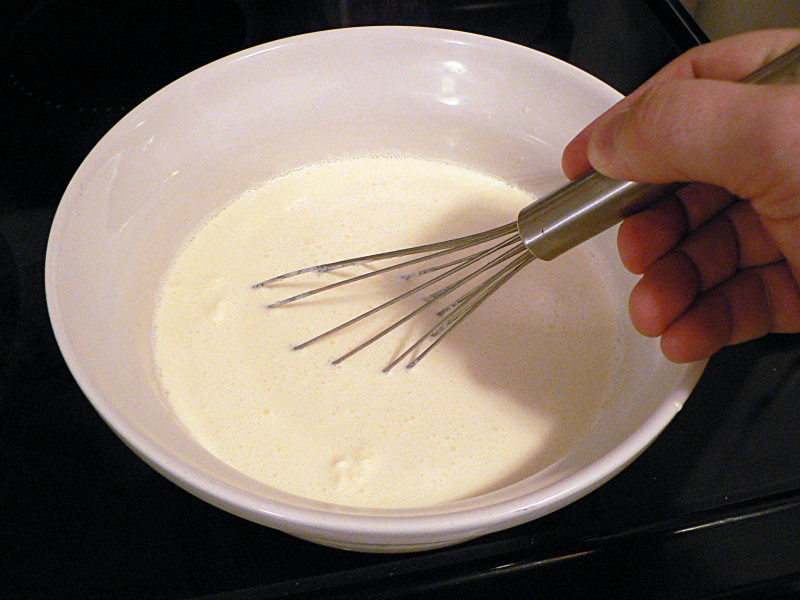
Whisk gently, by hand — you don’t want to start turning this into whipped cream — then cover the bowl with plastic wrap.
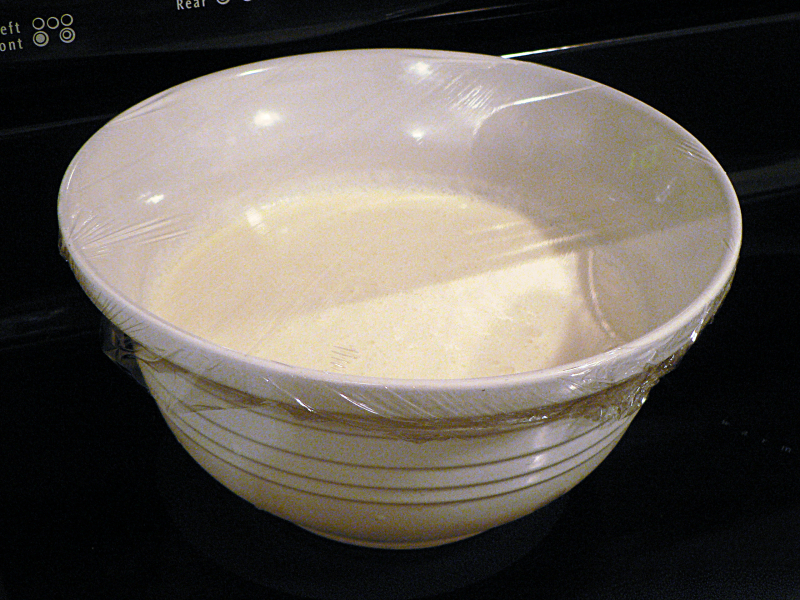
Set the bowl somewhere slightly warm overnight. Somewhere in the mid-70s Fahrenheit is perfect. It needs to be warm enough for the live cultures in the yogurt to grow in the cream. So this is perfect to make in the summer when the house is a bit warmer. It will work if it’s colder, but will take longer.

The next day, give the bowl a light shake. When the cream looks like it has thickened a little bit, it’s ready.

Beat the cream with your mixer until it starts to form peaks, then switch your mixer to its “Low” setting.
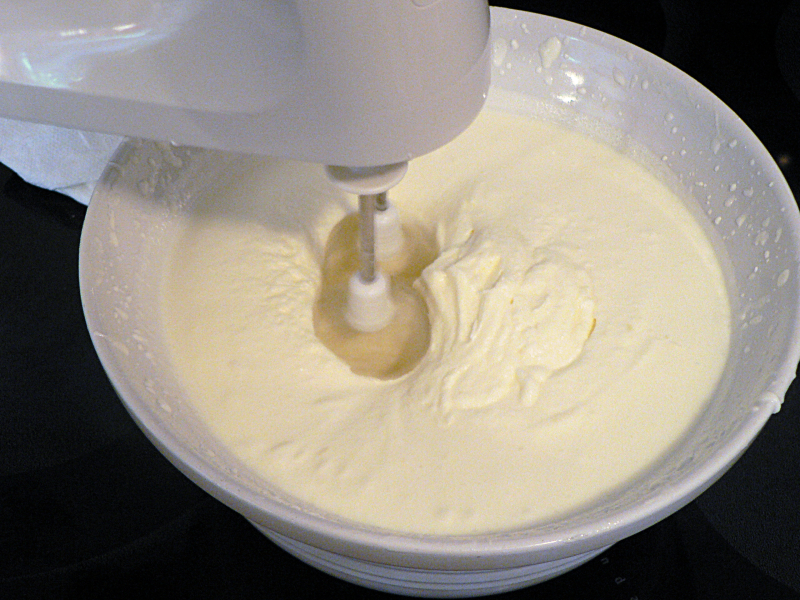
If your mixer only has one speed, like mine does, you might need to go a little old school.
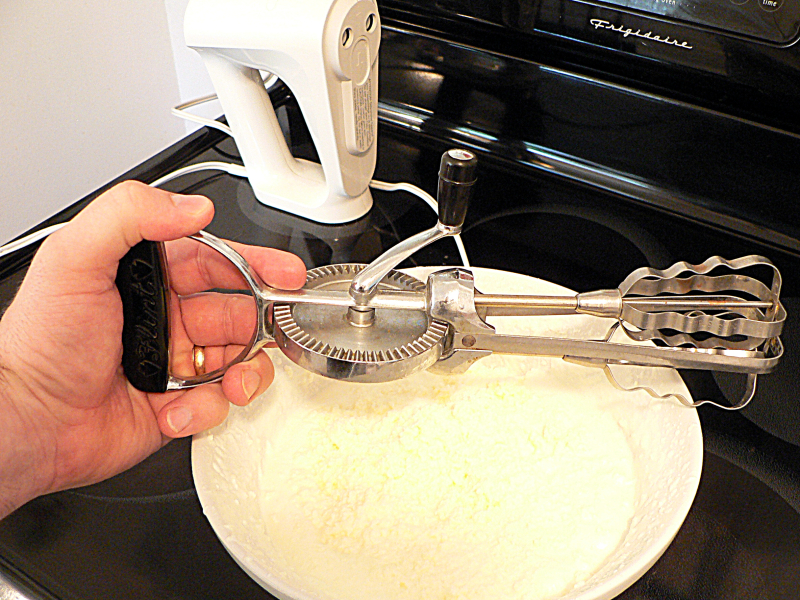
Yup, that was in my pantry, right next to the rolling pins, cast-iron pans and potato masher that are all probably older than me. When my wife’s great aunt passed away, while the other relatives asked for the quilts and lace we went to the kitchen. Nobody else even wanted anything. It would have ended up in a garage sale. Unbelievable.

The reason for the low speed is that just after the cream starts to form stiff peaks it will “break.” The milk solids will suddenly separate from the liquid all at once. If you’re still on high speed you’ll spray buttermilk everywhere.
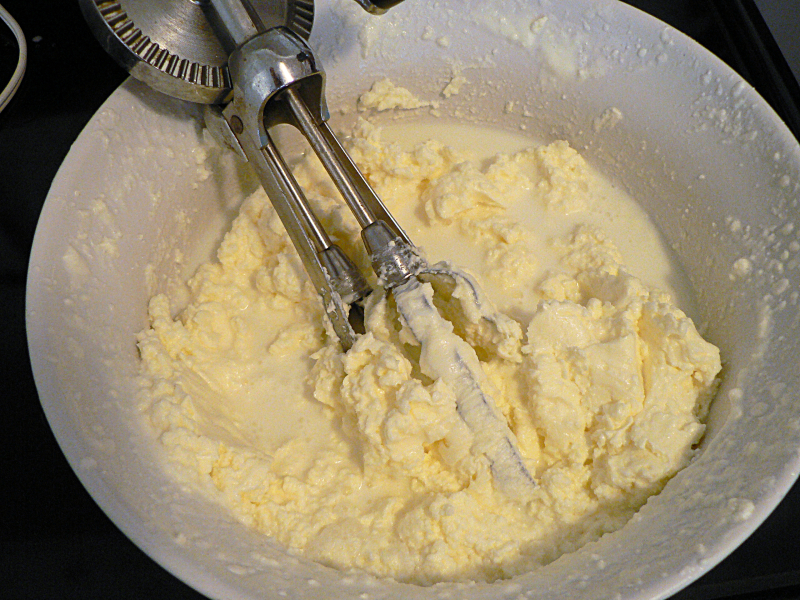
Don’t tell yourself, “Ahh, but I’m expecting it, so I’ll be able to not spray buttermilk everywhere.” You will be wrong. Wrong wrong wrong wrong wrong. Did I mention “wrong?” Look back at that picture above. See the spray around the edge of the bowl? Do you think that spray magically stopped right at the top of the bowl? No, it didn’t. (Take a guess whether I switched mixers before or after the cream broke.)

While holding back the butter, pour out the buttermilk.
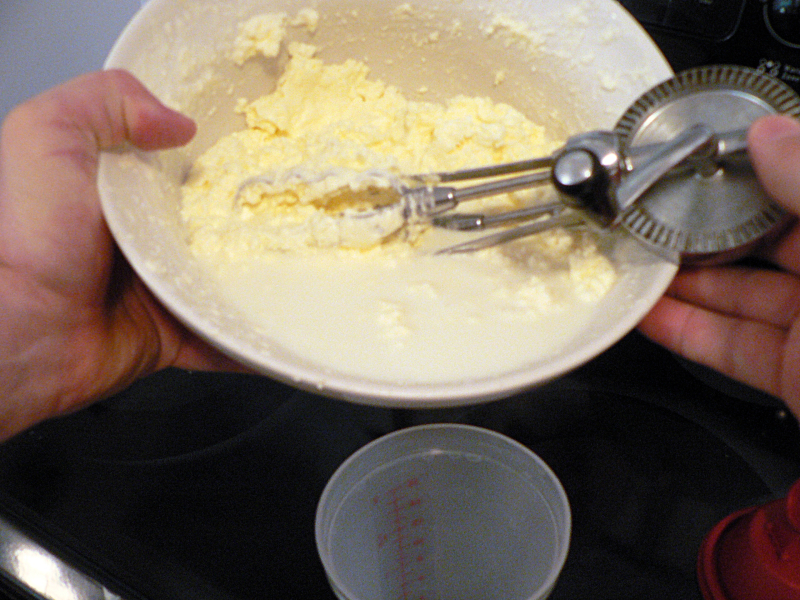
Catch yourself about to be stupid again and get a better strainer and a larger bowl.
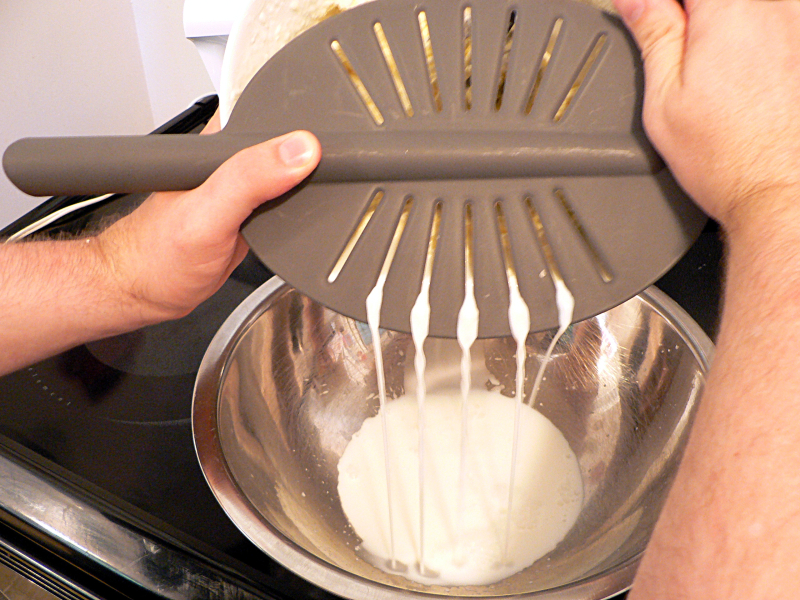
Ahh, much better. If you’re ready to use it all right away, you’re done.
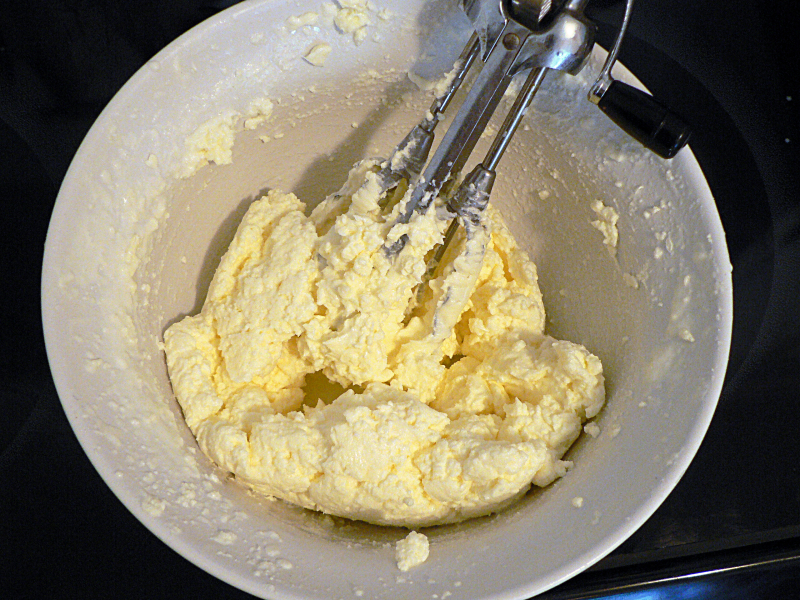
But probably you’ll want to be able to keep it for a while in the fridge. Press the butter with a spatula or the back of a spoon to squeeze all the buttermilk out. Get as much as you can; you should end up with two cups or more of buttermilk. (Can you say “buttermilk ranch dressing?” I can.)

Now one last step. Rinse the butter with cold water. Keep rinsing until the water runs clear. I know it sounds strange, but it works. And you have to do it or the buttermilk will turn rancid and ruin the butter. Pour off all the water and transfer the butter to a serving dish.
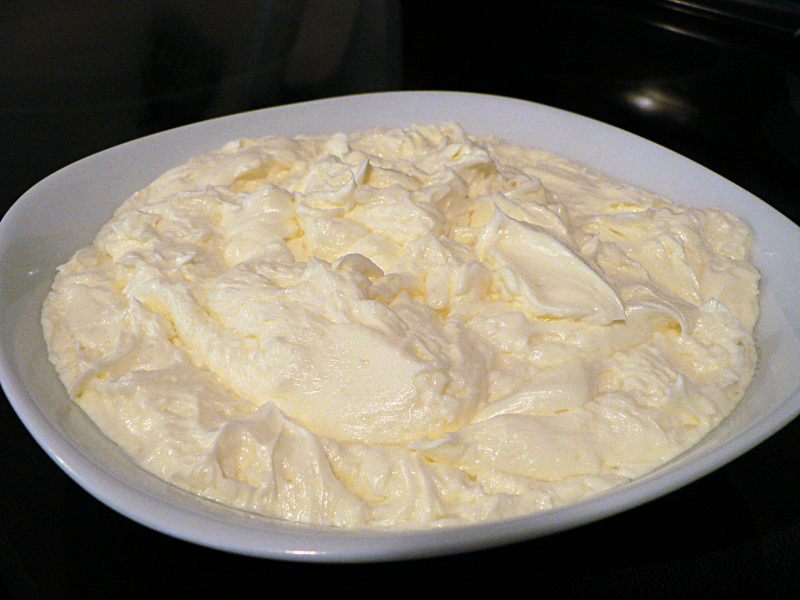
And that’s it.


If you’re the kind of person who slows down to check out accidents on the freeway, you won’t want to miss the next couple of days. I tried a new recipe and a new gadget and it was … disappointing. It was actually pretty close to what I wanted, but I spent way too much time for the payoff.

If you want to offer some suggestions, or just point and laugh, subscribe using the form to the right to get everything as soon as it’s published.

Want more like this? For more recipes like this, that you can hold right in your hands, and write on, take notes, tear pages out if you want (Gosh, you're tough on books, aren't you?) you might be interested in How To Cook Like Your Grandmother, 2nd edition, Illustrated. Or to learn your way around the kitchen, check out Starting From Scratch: The Owner's Manual for Your Kitchen.

This entry was posted in Dairy, Side and tagged , . Bookmark the permalink. Post a comment or leave a trackback: Trackback URL.

65 Comments

  1. Anonymous
    Posted August 12, 2009 at 4:13 pm | Permalink

    Thanks for the warning about when the butter "breaks." Now I know how to explain the mess I made in the kitchen using the proper terminology! The butter is still awesome. I got fresh milk direct from a dairy farm in PA and skimmed the cream. Also, after chilling the buttermilk, it looked and smelled so good I just drank it!

  2. Anonymous
    Posted September 4, 2009 at 12:52 pm | Permalink

    You could pour it all into a glass butter churn and paddle as slow as you want and when the buttermilk appears the whole mess is contained.

    Ann :o )

  3. Posted September 4, 2009 at 2:51 pm | Permalink

    A glass churn? Well how about that. I wonder if anyone is making new ones.

    Oh hold on … one of the listings calls them "Decorative Home Decor". Come on, I want to use this thing.

    Okay, here are some new ones, although the prices seem a bit steep for a pretty simple product.

  4. Storybook Woods
    Posted September 15, 2009 at 11:49 am | Permalink

    Oh you are brilliant. I will have to share this on my blog. Thank you. Clarice

  5. Posted September 15, 2009 at 12:04 pm | Permalink

    Clarice, I'm blushing. I believe the polite thing would be for me to agree with you. :-)

  6. Rebecca
    Posted September 25, 2009 at 7:31 am | Permalink

    Thank you for a brilliant post. I made butter last night that looked just like yours, and it was so reassuring to find your website today and see that I'd done it right! :)

    You certainly can buy new hand cranked glass butter churns. I've been looking around the US sites and they all seem to be in the region of $100. You could try eBay for a secondhand one and look for one that's described as secondhand (rather than "vintage" or antique as that commands a higher price these days). I saw a lid/paddle mechanism for $10 and a replacement jar is $14-20.

    Alternatively you could try somewhere like
    Lehman's for one (plus some other very interesting bits and bobs for the homebod.)

  7. Posted September 25, 2009 at 8:51 am | Permalink

    Rebecca, thanks for the suggestions, but I've already looked at both of those. No one seems to be making a hand-cranked any more, and all the old ones are being sold as decorative collectibles.

  8. Rebecca
    Posted September 26, 2009 at 5:23 pm | Permalink

    That's strange – Lehman's still has them listed on their website.

    I know for a fact you can get them in the UK new, so if you really want a hand cranked churn then try good old blighty :)

    BTW – I love your post about bacon camp – it made my day!

  9. Nickname unavailable
    Posted October 30, 2009 at 9:04 pm | Permalink

    I've accidentally made butter by over-whipping heavy cream that was intended to be whipped cream. This was made using a standard KitchenAid stand mixer with the whip. I also use the trick of putting a piece of plastic wrap over the top so I can whip on high without cream going everywhere. We never ate the butter, though, as it had sugar and vanilla and I didn't really think it was butter, since it was so watery. Huh. What a waster I am, could have had sweet butter biscuits or something.

    Anyway, the whole buttermilk + heavy cream, cover and leave overnight in a warm place thing, that's creme fraiche. At least, that's how I make creme fraiche, which is basically a milder sour cream. So you can make that into butter, too? Interesting. I think I'll try both ways, but what's the taste difference in store bought unsalted butter and this cultured butter? Is it very tangy? I don't know that I'd like that.

    Finally, as far as salted and unsalted butters go…it's always recommended with cooking to use unsalted butter (especially baking) because you can't control how much salt is in the butter. You generally will want to add salt, yes even to sweet things it brings out the sweetness, but you want to control it. If your butter is salted and you add salt, you may end up with too salty food. I use unsalted for cooking, salted for bread on the table. Although unsalted for the table isn't bad.

  10. Posted November 1, 2009 at 10:50 am | Permalink

    Nick, that sweetened butter could have been a wonderful accident. Too bad you didn't think to taste it.

    Although, considering what it looks like when cream first "breaks" into butter, I can understand why you wouldn't think to try.

  11. Corinn
    Posted February 25, 2010 at 5:14 am | Permalink

    Regarding a “glass butter churn”:

    I’m annoyed that I can’t find it online, but back in the Nineties there was this popular item that was a large, usually squat jar with a plastic lid. The lid had a bubble-like button or a raised pump on top, and pumping it by hand would cause a mixing element inside the jar to turn back and forth (if like a whisk) or move up and down (if like a potato masher). They were popular for beating eggs, but my fourth grade teacher and the docents at a local old-time farm-slash-museum used them to make butter and ice cream. Man, I want one now. I wish I could remember what they were called. I’ll have to ask my mum.

    Back in fourth grade, we also made butter by putting the cream in a jar and shaking it for like half an hour or more, like so. Fun for the kids, at least.

    What you could do is get a wide jar with a plastic lid and a grid-style potato masher, then cut a hole in the lid and slide the potato masher handle up it, put that in the jar, and voilà! Butter churn. Just pump the potato masher up and down. With a big enough jar or a coffee can, you could even use an egg beater. Gets repetitive, but it amused me as a kid.

  12. Posted February 25, 2010 at 9:07 am | Permalink

    Corinn, I’ve had my kids do the shaking thing before. Lots of fun.

  13. Travis
    Posted February 25, 2010 at 6:05 pm | Permalink

    Drew, Can a person use Ultra Pasteurized heavy cream to make cultured butter? Can cultured butter be frozen?

  14. Posted February 25, 2010 at 8:21 pm | Permalink

    All butter can be frozen. And yes, you can probably start with ultra-pasteurized cream, since your starter — whether yogurt, sour cream or a starter pack — will have the cultures to get it going. But if reviews are correct, and ultra-pasteurized has a “burnt” taste, why would you start with that, unless you have no choice? (Yes, I realize that in many grocery stores you’re lucky to get one brand of cream, so you take what you can get.)

    I just ran an article about the difference between pasteurized and ultra-pasteurized milk. You might want to check there for more details.

    • Travis
      Posted February 25, 2010 at 8:30 pm | Permalink

      My only choice is Ultra, sad to say. Having grown up on a dairy farm, I really notice the difference from farm and store. I read that article for “the difference b/t pasteurized and ultra” informative, but I still had the question whether it would work or not. Thanks for the info.
      I really like your articles keep up the good work, I hope more people get the idea of “from scratch” baking and cooking.
      Thanks again.

» Subscribe to comments on this post

Post a Comment

Your email is never published nor shared. Required fields are marked *

*
*

You may use these HTML tags and attributes: <a href="" title=""> <abbr title=""> <acronym title=""> <b> <blockquote cite=""> <cite> <code> <del datetime=""> <em> <i> <q cite=""> <strike> <strong>

  • Free Online Class

    Sign up now for my free 10-day online course in the basics: Starting From Scratch

  • Buy the Book


    Cooking used to be all about making food that tasted good. But somewhere along the way, we seem to have decided the diet-of-the-week was more important. How to Cook Like Your Grandmother is a return to recipes and techniques that are based on what tastes good, not on junk science and fad diets. You won't find the words lite, low, lean, free or skim anywhere. This is all real food, cooked the way Grandma would have done it.
  • Buy the Other Book


    People have been making and eating food as long as there have been people. And food. But somehow we've let ourselves believe that it's something only experts can do "right". That's where Starting From Scratch comes in. I'm not saying you'll go from zero to hero just by reading it, but at least now you'll know what those self-proclaimed experts are talking about.
  • Follow this blog

     Subscribe in a reader

    -- OR --
    To get recipes in your email
    Enter your email address:
    -- OR --
    Sign up for the weekly newsletter. Email address:
  • All-time Favorites

    Perfect Brownies French Onion Soup Bruschetta Pizza Egg Salad Onion Rings Banana Cake Cheesesteak Peach Cobbler Frozen Chocolate Truffle Pie Emily's Creamy Cheesecake
  • No Awards Please

Page optimized by WP Minify WordPress Plugin