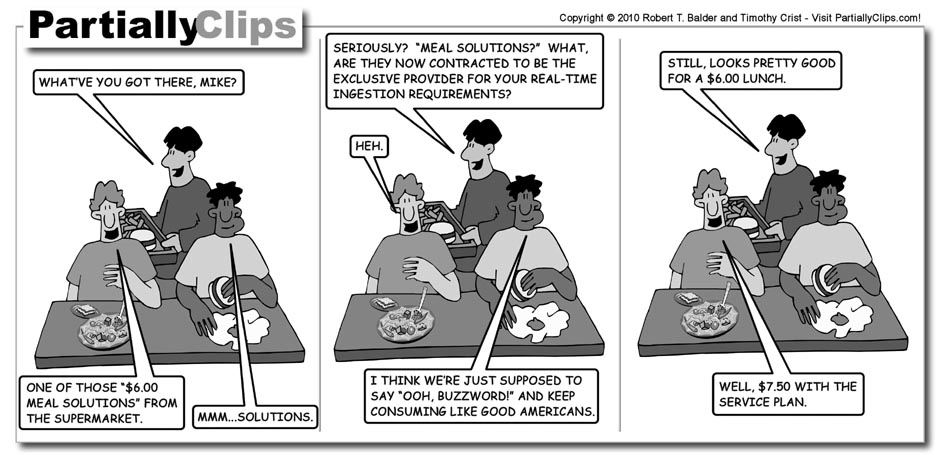
Here’s what the cartoonist had to say about this one:
True story. The store where I saw this also has “Meal Solutions” over the entrance in old-timey wooden letters, and the supermarket’s web address in old-timey wooden letters over the exit. There’s something somehow very strange about seeing a URL carved out of tree parts.
Click the image to go see it full-size, and check out the comments while you’re there. This definitely falls in the category of funny-because-it’s-true.

Want more like this? For more recipes like this, that you can hold right in your hands, and write on, take notes, tear pages out if you want (Gosh, you're tough on books, aren't you?) you might be interested in How To Cook Like Your Grandmother, 2nd edition, Illustrated. Or to learn your way around the kitchen, check out Starting From Scratch: The Owner's Manual for Your Kitchen.


2 Comments
Mmm… solutions. I’m guilty of this; the ones inside my local Trader Joe’s are surprisingly yummy.
Speaking of TJs, Drew, I know you enjoy frequenting your local farmers’ markets, but do you have any stance or input on Trader Joe’s or Whole Foods vs. your local supermarket?
I have an opinion, which may or may not be based on a well-reasoned analysis. So here it is, for what it’s worth.
I think both of them started out with the best of intentions, and most of the people working there and shopping there still have those same good intentions. The problem they’re facing is that industrial agriculture has discovered people will pay several times more for anything labeled “organic”. And the legal definition of the term allows producers to use most of the same bad practices that people are trying to avoid.
So there are probably a whole lot more good quality products in TJs and Whole Paycheck — excuse me, Whole Foods — than in the local grocery store. But shopping exclusively at those locations is no guarantee that everything you buy is produced the way you would like.
As always, the best solution is to buy as much as possible from the people who actually grow it, or as close as you can get to that. The more middlemen something passes through, the more you’ll be paying, the less you’ll know about where it came from, and the better the odds are that it’s just like everything else coming out of the industrial food system.