For special deals and more great content, sign up for the free How To Cook Like Your Grandmother Newsletter.
Email address:


Also receive blog posts via email

Name: (optional)

Not now, thanks

How Do You Pick Good Poultry?


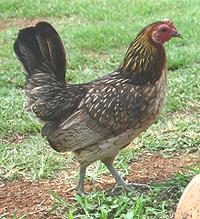
Photo of jungle hen by Adamantiaf distributed under license Creative Commons Attribution-ShareAlike v3.0.

I just spent the most frustrating half-hour online. I was looking for tips on how to identify good poultry. You know, like with steak you look for good color and marbling, with vegetables you want them heavy for their size and not soft or bruised.

But chicken? Can’t find a single word about it. Oh sure, there’s lots of stuff about different kinds of chicken: fryers, capons, Cornish game hen — yeah, “game”, not believing it. But when I’m looking into the meat counter at the grocery store, how do I pick the best one?

Paging Don Quixote, call on the white courtesy phone

I suspect the answer is going to be that chickens are so uniform that there isn’t any noticeable difference from one to the next. But I don’t want to believe that.

No matter how much factory farms come to resemble sterile production lines, I still want to think that chickens are basically animals. Which means they shouldn’t all be the same. And if they’re not all the same, then one of them in each batch should be the “best”.

Am I tilting at windmills here? Am I looking for something that doesn’t exist? Or is there someone out there who can tell me what to look for when I’m looking at two chickens, so I can choose between them?

And by the way, I know that if I find a local supplier of pastured chickens, they’ll be better than anything in the grocery store. So when I’m looking at pastured chickens, how do I pick the best one?




Want more like this? For more recipes like this, that you can hold right in your hands, and write on, take notes, tear pages out if you want (Gosh, you're tough on books, aren't you?) you might be interested in How To Cook Like Your Grandmother, 2nd edition, Illustrated. Or to learn your way around the kitchen, check out Starting From Scratch: The Owner's Manual for Your Kitchen.

This entry was posted in Uncategorized. Bookmark the permalink. Post a comment or leave a trackback: Trackback URL.

25 Comments

  1. Farmgirl Susan
    Posted July 27, 2009 at 6:17 pm | Permalink

    I buy local pastured chickens from people I know and trust. When I pick them up at their farm on processing day, they simply give me the number of chickens I ordered – there's no picking and choosing, though I suppose I probably could if I wanted to.

    I do specify when I place my order that I want large ones because I think you get more meat for your money with a bigger bird (I like them to be about 5 pounds). My roundabout point is – I've never had one that wasn't ridiculously delicious! : )

    There really is a difference in how chickens are raised and how the resulting meat tastes. I haven't bought supermarket chicken in 14 years, but a few years ago I was talking to an acquaintance about how good these peoples' pastured chickens were, and she said, "They don't have that icky yellow layer of fat that the supermarket ones do." I didn't know what she was talking about, but it sounded pretty disgusting. : )

    Pastured poultry costs more than convential, but it's definitely worth it. What's funny is that chicken is considered our splurge/special occasion meat since we raise our own lamb and beef.

    *stepping down off soapbox*

  2. Ryan
    Posted July 27, 2009 at 6:26 pm | Permalink

    I'd suggest getting a copy of the River Cottage Meat Book from the library. Essentially you're looking for good muscle tone, smaller breasts than you're used to seeing on a conventional chicken. Lack of bruises or broken bones, taut skin. Yellow skin is from producers adding marigold petals to the feed.

  3. Ryan
    Posted July 27, 2009 at 6:32 pm | Permalink

    I forgot to mention, depending on the application you might want a younger or older bird. For making stock, I'd suggest looking for an old laying hen or old cock. For roasting at high temp look for a young bird. A good indication of age is the flexibility of the end of the keel bone, younger birds should have a fairly flexible one.

  4. Talitha Borealis
    Posted July 27, 2009 at 6:50 pm | Permalink

    Cook's Illustrated had a book called the Complete Guide to Poultry, about all bird-ish things aplenty, from chickens to ducks and such. It's quite good, but I don't recall if they had a section on choosing the meat itself. They might.

  5. Linda
    Posted July 27, 2009 at 7:00 pm | Permalink

    A number of years ago, I helped butcher chickens. Oh my, I never want to do that again. I can't hardly cook a whole chicken anymore. I usually buy chicken breasts, or even chicken that is already cooked.

    Anyway, that is my 2 cents worth.

  6. Posted July 27, 2009 at 8:05 pm | Permalink

    Susan, that's no soapbox. That's just plain old bragging. :-) Hmm, maybe if I find a local source that's what I'll do, have that as the splurge dinner.

    Ryan, it took me four sites that were showing how to butcher a chicken before one of them had good pictures and a simple description. "Oh, you mean the bone in the center of the breast. How hard is it for them to say that?" Thanks for the pointer, I'll check my library. (By the way, I knew about the marigolds. Brilliant marketing.)

    Talitha, I'll look for that one too, thanks.

    Linda, okay … thanks for the tip. :-D

  7. Elizabeth
    Posted July 28, 2009 at 12:04 am | Permalink

    I have always wanted to cook like my grandmother aka Granny. Thanks!

    I gave you an award :) Go to my blog to check it out!

  8. Anonymous
    Posted July 28, 2009 at 12:14 am | Permalink

    The first thing you want is a butcher you can talk to. Ask him about where he sources his chickens and why. Do this with a couple of different butchers and it will become obvious why some are better than others.

    The second thing you want to do is to smell and feel the different chickens he has for sale. Bring along a box of plastic bags, pull one and put it around your hands in front of the butcher. Ask to smell and handle the alternatives.
    Any good butcher will respect you for it. Talk to him about your experiences and learn.

    Remember what you smelled and felt and what kind of results it produced. Do this by writing it down. You will be surprised at what a wonderful resource you develop with just a few experiences.

    If you love it and are smart, you will get very good at it.

  9. onlinepastrychef
    Posted July 28, 2009 at 5:53 am | Permalink

    Everyone's pointers seem right on the money. I'll add that you want the wing tips to be light in color. If they are dark and veering towards brownish, it's old blood (ew), an indicator of less-than-fresh.

    We buy local chickens from the farmer's market here. They live happy little chicken lives until they are killed, gutted, plucked and flash-frozen for our later enjoyment. Best chicken I've ever had, although I'd like to go shop where Farmgirl Susan goes, too:)

  10. Posted July 28, 2009 at 8:10 am | Permalink

    Anon, I don't think my butcher would mind me doing that, as long as it's not super busy at the time. And early Saturday, when I usually get to go, is pretty busy.

    Jenni, I guess that means I need to see one with the wings still attached.

    By the way, I got an email with a few other tips: Press a digit into the flesh and it should bounce back immediately. Pastured chicken is going to be tough, all that muscle from pasturing around — stew and soup, not fried or roasted. Anyone else heard that, about pastured chicken being tougher?

  11. Farmgirl Susan
    Posted July 28, 2009 at 8:37 am | Permalink

    I've never found the pastured chickens we buy to be tough, and I always roast them, either whole or in pieces. I think it all depends on your source. I've read more than once that grass fed beef is tough, and yet you can practically cut our homegrown steaks (that we just toss on the grill until rare or medium rare) with a butter knife.

    It may depend on the breed of chicken. I know that there are only certain breeds of cattle that do well finished out on grass – Black Angus being one of them. Either that or they're just not cooking their chicken right. ;)

  12. Farmgirl Susan
    Posted July 28, 2009 at 8:44 am | Permalink

    Something else I just remembered. When I pick up my chickens they've just been butchered that morning and are still fresh (not frozen). The sellers tell everybody that if you're going to eat one fresh (most of us buy a bunch at one time and freeze them) you should let it chill for 24 hours first. If people are purchasing pastured chickens that haven't 'aged' (other animals like lambs and beef they hang in the cooler for up to 14 days, hogs hang for a day) they may find them tough.

    I've always put mine straight into the freezer when I get home (because who has room for 10 chickens in their fridge LOL) and have never found them to be tough, but I was talking to a neighbor the other day (who is actually going to raise and butcher some pastured chickens for us this year) and she said she always likes to let them chill in the fridge for two or three days before freezing – and said she has enough space to chill mine, too. It will be interesting to see if I can notice any differnce.

  13. melissa
    Posted July 28, 2009 at 9:35 am | Permalink

    We raise pastured chickens (and turkeys) and I agree that aging them makes the best flavor and texture. I too like them to be in the 5lb range so I can get more than one meal from the effort; farmgirl is right about the meat/bone ratio at this size making them a better value. They're 6-8 wks. old when butchered and are never tough. I think processing is crucial; the water can't be too hot, chix not stressed before butchering, etc. And the taste…!

  14. Mom2Be
    Posted July 28, 2009 at 10:37 am | Permalink

    I was going to ask my farm-raised hubby about this but looks like you got some good answers already. : ) Definitely go local and avoid companies like Tyson at all costs…they're the devil! ; )

  15. Alicia
    Posted July 28, 2009 at 12:33 pm | Permalink

    It looks like you have been getting a lot of good tips from people already. As a librarian, I have been seeing a fair amount of books lately about raising chickens – they might have good information on the different breeds that are raised for consumption (different from those raised for their eggs). One book I've found is called "Living with Chickens" by Jay Rossier. Try your local library, they might have some books that could help your search.

  16. Posted July 28, 2009 at 1:18 pm | Permalink

    Susan and Melissa, great tips, but it's still confirming what I noticed at the beginning: Most of what makes one chicken better than another, you can't see once it's in the butcher's case.

    Mom2be, don't hold back, tell me what you really think.

    Alicia, I suspect most of those are going to be raised for eggs. I'm seeing a lot of discussion about that all over the place.

  17. Jeannine from Pittsburgh
    Posted July 30, 2009 at 11:18 am | Permalink

    I think a very large reason most chicken tastes the same is that, for the most part, it's just one breed that's sold for meat: the Cornish cross. Even the farmers who I purchase eggs from raise only Cornish cross birds to sell for meat. They grow at a very fast rate, have white feathers (and hence no skin discolorations), and offer a good return on investment for poultry farmers. Even though the farmers I buy the birds from raise them on pasture, they say the Cornish cross birds don't want to do much other than eat their grain.

    Many of the breeds of chickens that are discussed in books about raising backyard chickens were bred to be dual-purpose (meat and eggs) so I think Alicia has a point. I'd love to taste something other than a Cornish cross, but not sure where I could find one. On "Return to River Cottage" Hugh Fearnley-Whittingstall raised his own birds for a taste test, and found the best to be a Dorking crossed with an Indian Game cock.

  18. Posted July 30, 2009 at 11:43 am | Permalink

    I can't finish this joke and keep a PG rating, so let me just point out that you said "dorking" and "game cock" in the same sentence.

  19. Jeannine from Pittsburgh
    Posted July 30, 2009 at 12:29 pm | Permalink

    I'll blame that on the Brits! They do have a colorful way of naming things (see links below). But there really is a breed of chicken called a Dorking. It's from Roman times, is supposed to have a lovely disposition, is a good egg layer, and it's also good to eat!

    http://www.nytimes.com/2009/01/23/world/europe/23crapstone.html

    http://www.populationstatistic.com/archives/2009/01/23/a-guide-to-funny-british-placenames/

  20. Anonymous
    Posted August 3, 2009 at 10:08 pm | Permalink

    I've been raising various breeds of chickens for over 15 years. My folks and grandparents all raised chickens and my dad was a USDA poultry inspector. We have butchered our own and we have hired the butchering done, no taste difference.
    All chicken sold for meat is the cross between a white Rock hen and a Cornish rooster, thus the Cornish Rock broiler. They are a hy-bred that really only thinks of one thing and that is eating. You have to remove the food for 12 hours a day or they will eat themselves to death. They can have heart attacks. They can also gain so rapidly that their legs can't keep up with the weight gain.
    I have grown them up to 8 to 10 pounds for a nice roasting bird. The local Amana colonies and Mennonite colonies sell home raised broilers. I believe there is a colony from around Sioux Falls, SD that sells over the internet.
    A dual purpose bird, such as the Plymouth Rock or Rhode Island Red will never be as tender as the broiler. They never get nearly as large either. The taste isn't much different. But we eat the cockerels we hatch ourselves.
    I don't know if you are aware of egg quality differences. Eggs come in various shades of white, brown and green. The shell means nothing about the quality of the egg. Hens with white ear lobes lay white eggs, hens with red ear lobes lay brown eggs and Arcana/Americana hens lay green eggs. A young female is called a pullet. Her eggs will be the most densely nutritious. She will cycle between lays and molts, with each additional lay, her egg quality will diminish. On each store carton of eggs is an ink stamp. The P will tell which plant the egg came from, there will be a number between 1 and 365, that is the day of the year the eggs were put in the carton, not the day the egg was laid. But it gives some idea of freshness. A small blood spot can be found in very fresh eggs, it would dissipate with age. Don't worry about it. A good egg will have a strong shell. When cracked the yolk will stand high, the white will also be formed and there should be very little water. The nutrition found in an egg is second only to mother's milk. There, more than you wanted to know, but really only a fraction of what I could bore you with.

  21. Posted August 4, 2009 at 7:59 am | Permalink

    Anon, thanks for all the details. But you know … the more info people offer, the more convinced I am that no one really has any tips for choosing between two chickens once they're slaughtered. (Except the tip about the flexible keel bone to indicate age.) This was a complete surprise to me.

  22. Nistuj
    Posted August 4, 2009 at 10:35 am | Permalink

    With steaks, marbling isn't necessarily a good thing, it just means more fat and the cow has eaten too much corn. As for colour, that too is faked with gases added to the take home container.

  23. Wyv
    Posted August 24, 2009 at 9:58 pm | Permalink

    Unless you're talking Wagyu beef, in which more marbling = oh so absolutely mind-bogglingly tasty!

    But we're talking chickens, so ignore that outburst. :)

  24. Posted August 25, 2009 at 10:51 am | Permalink

    Wyv, that's the story I keep hearing that drives me nuts. Do these women think that when they're gone people are going to be glad no one ever learned how to make their specialties?

    Give a man a fish, feed him for a day. Teach a man to cook fish … Yeah, that works.

  25. Julia Smith
    Posted January 28, 2010 at 12:19 pm | Permalink

    Grandma raised chickens and said red or dark wingtips are a sign of an old (stale not mature) bird. She also remarked that there is no comparison between a store-bought bird and a freshly butchered one—they are like two different creatures. I know it’s true for rabbits…I lived down the road from a man who’d go out and wrap me up a couple of rabbits still warm. I loved that rabbit, and when I moved to the city was excited to find rabbit in my grocery store…only to find that even after multiple tries, it was gamy and just “off” tasting. Good luck!

» Subscribe to comments on this post

Post a Comment

Your email is never published nor shared. Required fields are marked *

*
*

You may use these HTML tags and attributes: <a href="" title=""> <abbr title=""> <acronym title=""> <b> <blockquote cite=""> <cite> <code> <del datetime=""> <em> <i> <q cite=""> <strike> <strong>

  • Free Online Class

    Sign up now for my free 10-day online course in the basics: Starting From Scratch

  • Buy the Book


    Cooking used to be all about making food that tasted good. But somewhere along the way, we seem to have decided the diet-of-the-week was more important. How to Cook Like Your Grandmother is a return to recipes and techniques that are based on what tastes good, not on junk science and fad diets. You won't find the words lite, low, lean, free or skim anywhere. This is all real food, cooked the way Grandma would have done it.
  • Buy the Other Book


    People have been making and eating food as long as there have been people. And food. But somehow we've let ourselves believe that it's something only experts can do "right". That's where Starting From Scratch comes in. I'm not saying you'll go from zero to hero just by reading it, but at least now you'll know what those self-proclaimed experts are talking about.
  • Follow this blog

     Subscribe in a reader

    -- OR --
    To get recipes in your email
    Enter your email address:
    -- OR --
    Sign up for the weekly newsletter. Email address:
  • All-time Favorites

    Perfect Brownies French Onion Soup Bruschetta Pizza Egg Salad Onion Rings Banana Cake Cheesesteak Peach Cobbler Frozen Chocolate Truffle Pie Emily's Creamy Cheesecake
  • No Awards Please

Page optimized by WP Minify WordPress Plugin