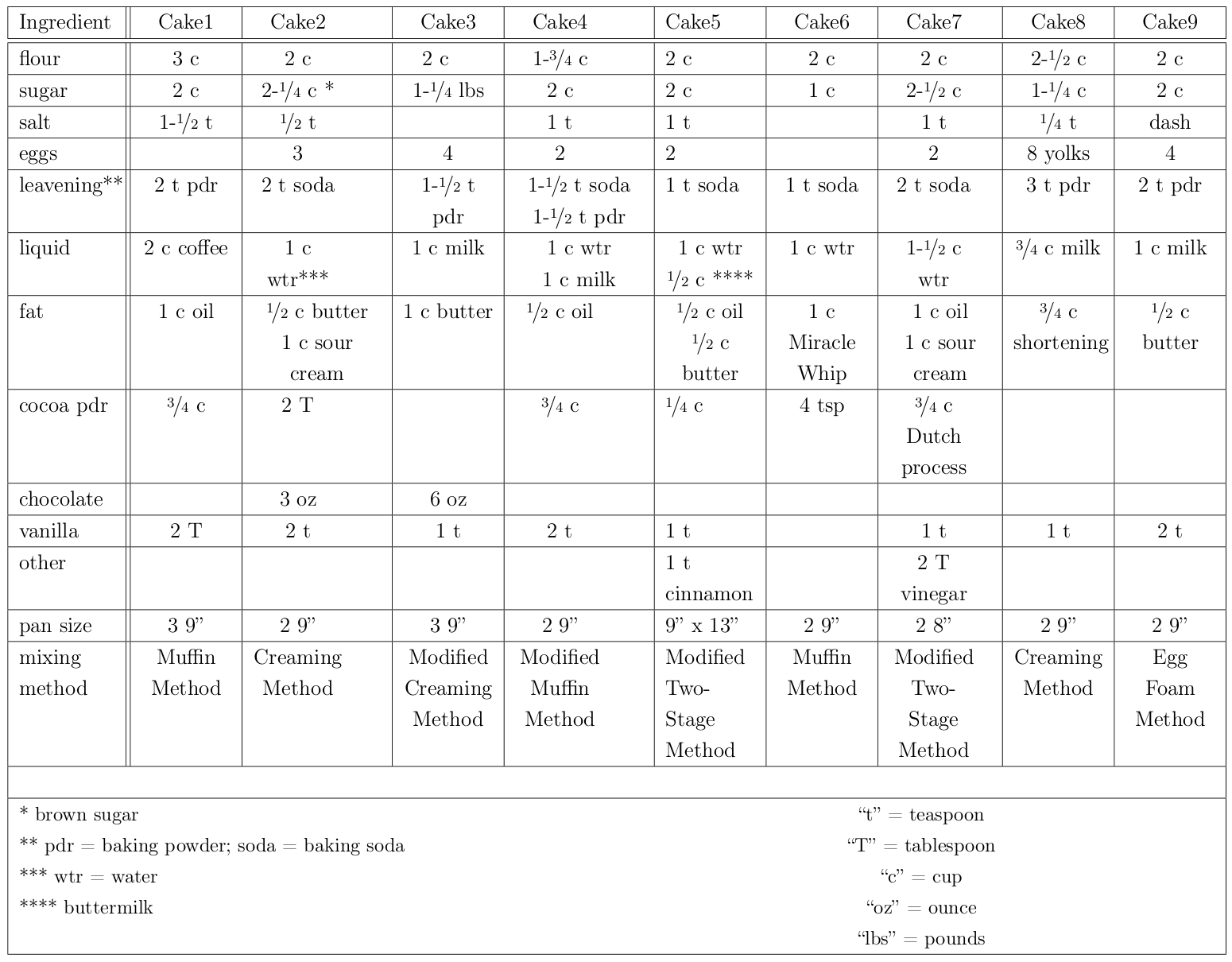
Have you ever had someone completely exceed your expectations? Jenni, the Online Pastry Chef just did. I asked your for your favorite “can’t miss” birthday cake recipes, and posted the responses. Then I asked Jenni, “Hey, could you take a look at these and tell me how they would be different?”
She must really like analyzing recipes, because what I got back was amazing.
You can click the chart above to see the full-size version of it. Then you’ve got to go look at the analysis on Jenni’s site. Random selections:
The cakes that do not contain eggs use a lot of liquid fat — Cake 1 uses 1 cup of oil, and Cake 6 uses 1 cup of Miracle Whip (basically oil and a little egg and sugar). Eggs are good for binding and tenderizing, so upping the fat ups the tenderness.…
The deal with acidic ingredients is that you want a batter to be neutral in pH or only very slightly acidic in order for the batter to set up properly. If the pH is too high — the batter is too “basic”, or alkaline — the cake will never set up, and you’ll just end up with hot pudding.
…
If this cake bakes up how I think it will, just based on its ingredients, it looks like it would be ridiculously overleavened and then collapse in a heap.
…
Oh, if your batter is too alkaline, it will taste like soap. Trust me; this is not a Desired Flavor in a Baked Good.
When I asked what she thought, I was expecting something like, “Oh, the first one will be really rich, and the fourth one light and fluffy.” Jenni seriously over-delivered. Go check out the rest of it even if you’re not looking for a cake recipe just now. It’s interesting to see how a pro reads a recipe.



8 Comments
Drew! You made my chart look amazing! Thanks for saying such nice things:) Oh, and I have to go update my post, too. I just remembered that Shirley Corriher often subs extra leavening in place of eggs, so that cake that I was worried about might be okay, since it didn't have eggs in it. Science is fascinating:)
Feel free to grab it to post on your site. I think the only change I made was separating the pan and mixing method rows. This is exported from … umm, our "project under development", so you might want to proofread it just in case.
Thanks, Drew:)
Jenni, I didn't realize I would find someone as (obsessed, enamored, delighted) with AB as I am. I've been in withdrawl since I moved out to the country where I can't get Food Network. Thank goodness for You Tube & my sister (who has sent me almost every Good Eats DVD).
Drew, It's amazing how much our grandmothers knew. All the chemistry involved in a simple cake.
Stephanie, I'm betting most of them didn't know the chemistry, but they could probably tell you from experience what substitutions would lead to what changes in the texture.
My brother sent this thread to me because I tend to assemble and multi-plex my recipes in this manner. I have risotto and souffe spreadsheets, for example, that I've shared with folks on Chowhound.
What's not to like, I ask?
Karl, this is the first time I've ever seen it done, and now you're the second. Have you seen anyone else do this? Is it a culinary school kind of thing? I mean, this is really studying the subject. If they don't teach things this way, they should.
Some might call it a leeeetle bit obsessive. But not I!
We actually rarely studied formulas side by side like this. I think it's a good way to lay it out so the similarities and differences are easily spotted.