Some bread recipes, and almost all cake recipes, tell you to grease and flour a pan. Some just say to flour a pan, but it means the same thing. It’s just coating the pan so that the baked goods don’t stick.
Usually they assume you already know how. If this is your first time, here it is, in two quick steps.
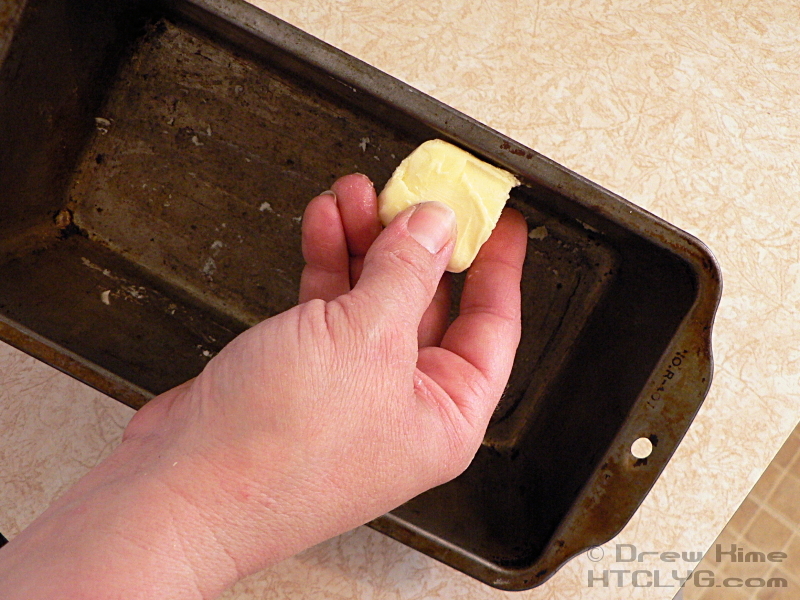
Rub a stick of butter around the inside of the pan until it is completely coated. Pay attention to the corners and edges, make sure you get them.
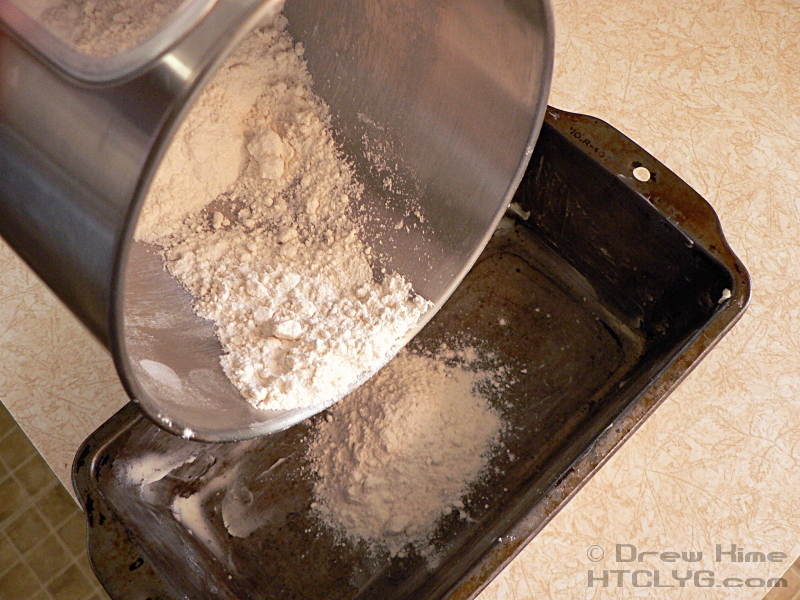
Add about a cup of all-purpose flour.
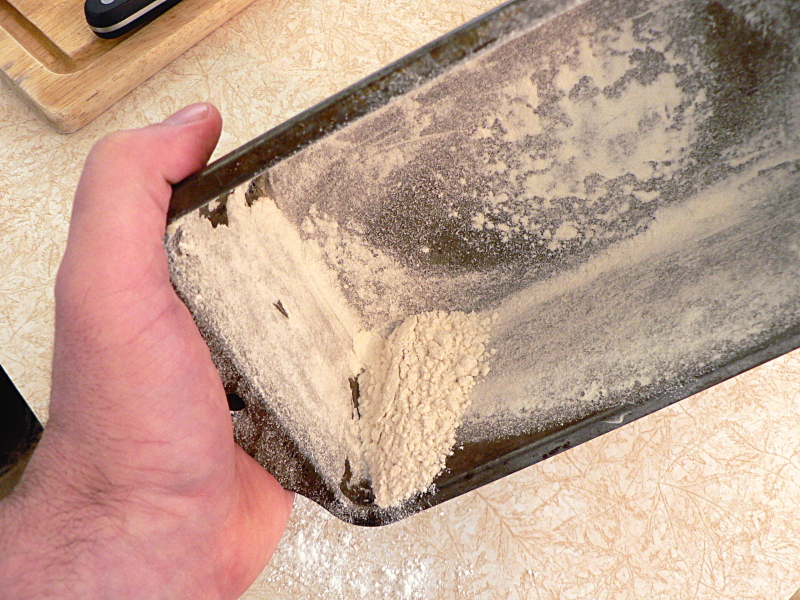
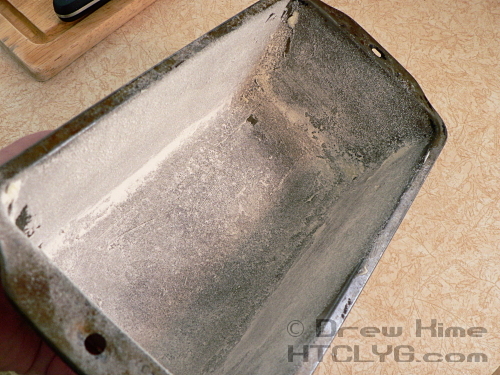
Tip the pan all around, tapping with your other hand, to make sure the flour sticks to all surfaces, then dump out the excess.
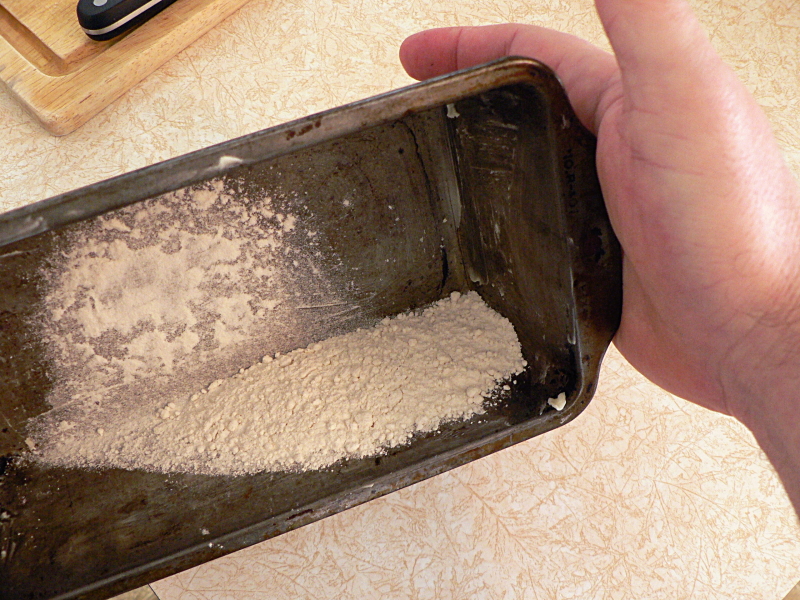
And that’s it.
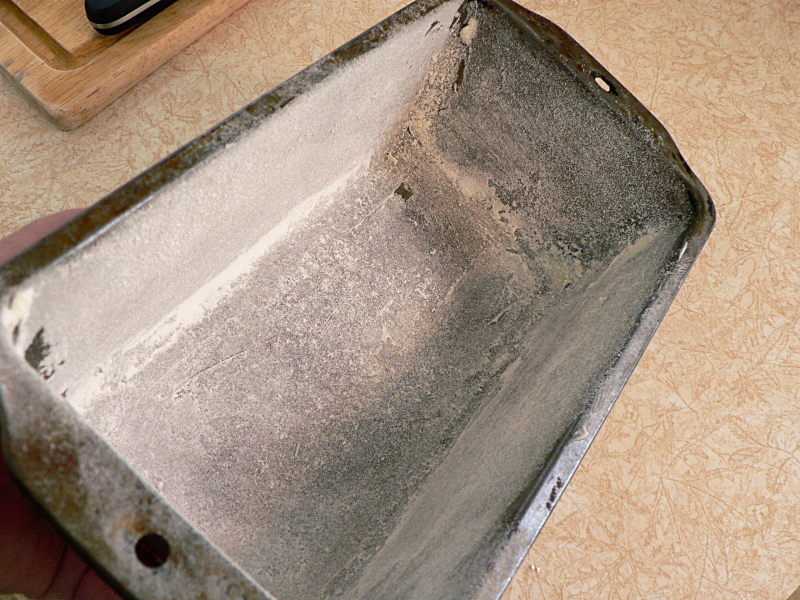
This works better than any spray, and it’s all real food, too.
UPDATE: As a few people mentioned below, you can use cocoa powder instead of flour if you’re doing a chocolate cake.



13 Comments
I love the look of that pan.
What do you think is the advantage of flouring over just greasing?
Batters need something to adhere to… better the flour than the pan! In other words, you grease the pan so nothing sticks to it. But you flour the grease so the batter has something to climb up as it rises during baking. Is that correct, Drew?
I’m sure Jenni will correct me if this is wrong, but here goes.
Flour doesn’t get sticky until it hydrates — or absorbs moisture. Unless the butter is melted, the flour won’t absorb moisture from it very quickly.
This dry barrier keeps the batter from touching the butter while the outer layer of the batter starts to cook. Once the batter has formed a crust, the butter keeps it from sticking.
My grandma would use cocoa powder when making a chocolate cake. Any thoughts on that?
So, if I use Baker’s Joy is that considered cheating? LOL
Stephanie, if that works as well as flour does then I’d have to reconsider my explanation for why it works. Hopefully Jenni will drop in to set us straight.
April, usually I don’t like non-stick sprays because they add flavor. Then there’s the MSDS (Materials Safety Data Sheet). And finally this from their FAQ:
Q: What type of oil is used in Baker’s Joy spray?
A: Baker’s Joy spray includes heart-healthy soybean oil, considered the healthiest of all cooking oils. In fact, 85% of its composition is made up of polyunsaturated and monounsaturated fats…the ones that are good for you.*
*United Soybean Board, Consumers’ Perception of Soy: Why it Might Pay to Have it on Your Label, 3/17/2000.
So the United Soybean Board considers soybean to be the healthiest of all cooking oils. Well, that certainly settles that issue. :-/
The hottest part of the batter is the part that is right up against the hot metal pan. Since most cake batters contain a lot of sugar, the outside caramelizes fairly quickly. That’s why you get a nice golden crust on cakes and such–caramelization plus additional browning due to Maillard reactions. Caramel is sticky. The flour or cocoa powder–like Stephanie’s grandma, I use that, too, for choc cakes–acts as a barrier between the caramel and the pan.
No greasing for angel food cakes, sponge cakes or chiffon cakes, though. In these cases, if the batter (which is very egg-heavy and may only be leavened w/an egg or egg white foam) wasn’t allowed to stick to the sides of an aluminum pan, it would have a hard time rising–the sticking gives the starches time to set up. This is also why lots of these types of cakes are cooled upside down, to keep them from collapsing before the structure is completely set. Having said that, I agree w/B.Cool that most American style butter cakes rise better in floured pans because they have a rough surface to climb.
Drew, I think you’re on the right track, too. Bottom line: I don’t think there is one definitive answer as to why the greasing/flouring keeps cakes from sticking–all these reasons are viable.
I had no idea about not greasing the angel food. How do you get it to release wen it’s done?
As for my explanation, I was basing it on what I know of frying battered foods. You need to let them rest for a while after dipping to let the flour hydrate and glue the layers together, or your batter will all come off in one big layer when you fry it.
With cakes it’s the exact opposite. You need to get it into the oven immediately after pouring it into the pan because you want those layers to stay separate.
Fascinating discussion.
Hey, Drew. Yeah, for angel food cakes (and similar), you just bake them in a 2 part angel food pan and let cool upside down. Then, you do the skinny knife trick to release the sides, slide the two sections apart and do the skinny knife trick again to get the cake to let go of the bottom and cone of the pan. Kind of a pain, but there you have it.
If I am making a chocolate cake I like to use coco powder to “flour” the pan. This keeps a white dusting off your cake.
CI used cocoa power on my last chocolate cake after I read that it would work like flour, but my cake stuck like I hadn't used anything on the pan. When I finally got them out of the pan, they were in pieces and I had to use frosting to hold them together
. Tasty, but not ideal. What did I do wrong? I coated the pans with butter, then used the cocoa powder in place of the flour.
Wow, sorry to hear that. It's hard to guess without knowing what recipe you did, and a whole lot more details, like: how warm was the butter, how long did the batter sit in the pan before going into the oven, was the oven thoroughly pre-heated, etc.
I know I always over-do it with the flower or cocoa, because I hate sticking.
2 Trackbacks
[...] the batter into three greased and floured round [...]
[...] a loaf pan (click here for directions on flouring a pan) and pour in the [...]