Pie crusts aren’t all that hard to make, but they can be a bit time consuming. So if you’re already busy with a big meal, it’s tempting to just get a pre-made crust and add some filling.
With this trick, you can easily do the crust a day or more ahead of time. You’ll save lots of time on cleanup, too.
Ingredients
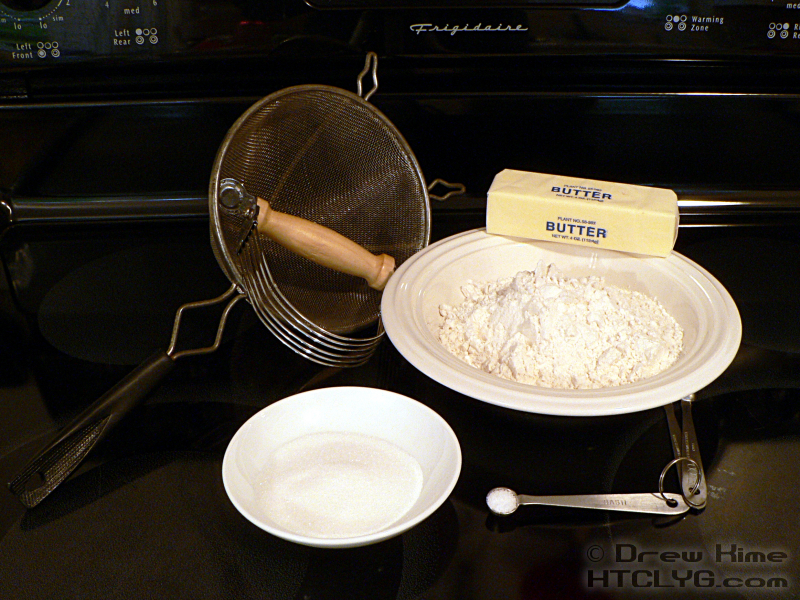
1-1/3 cups flour
1-1/2 tablespoons sugar
1/4 pound (one stick, eight tablespoons, 1/2 cup) butter
1 dash salt
3 tablespoons cold water
Directions
Sift the flour, sugar and salt together.
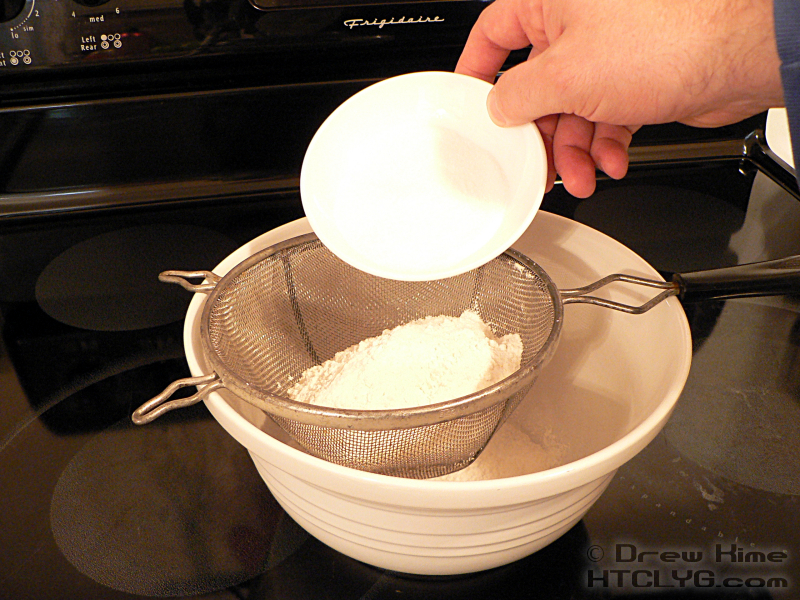
Don’t know what “sifting” is? Watch this quick video.
Oh, and how much is a “dash” of salt? I’m not sure, I just use the measuring spoon.
(Okay, it’s about a quarter-teaspoon. If you’ve got “normal” measuring spoons you’ll have that one.)
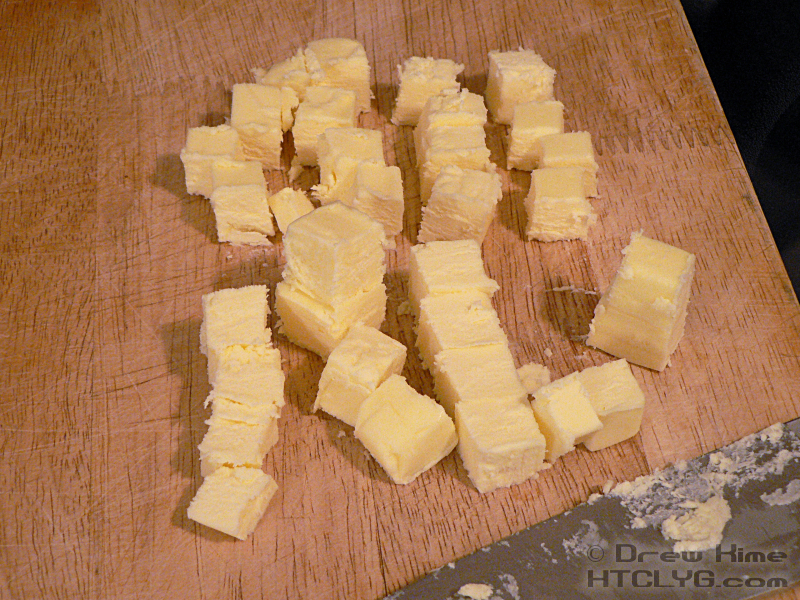
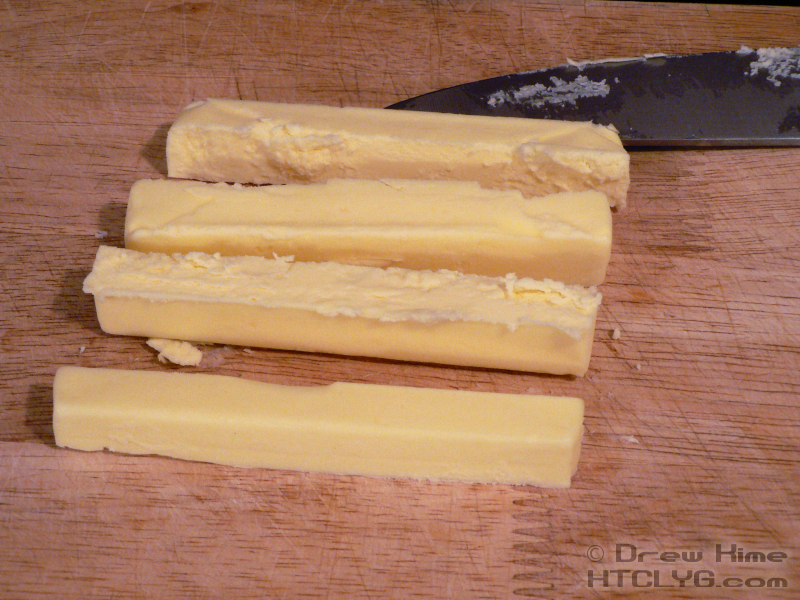
Now cut the butter into small chunks. Make sure it’s nice and cold or it will stick to your knife.
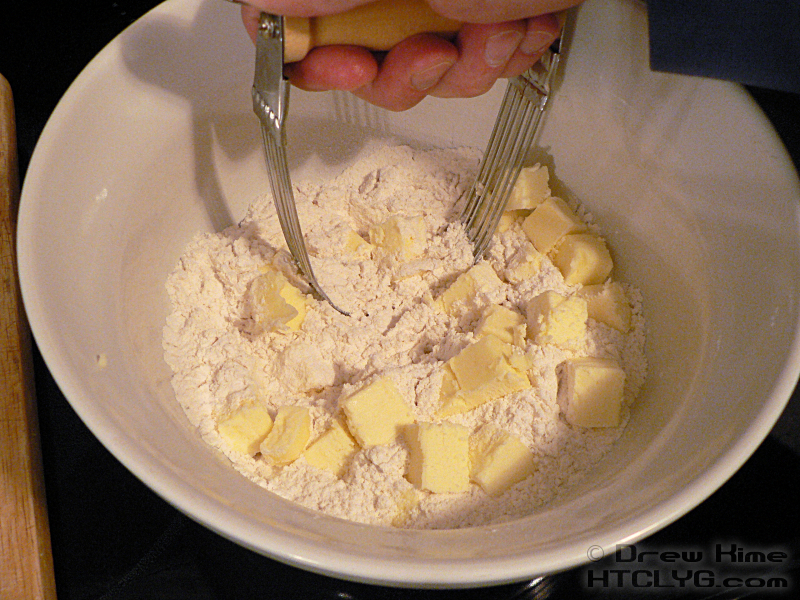
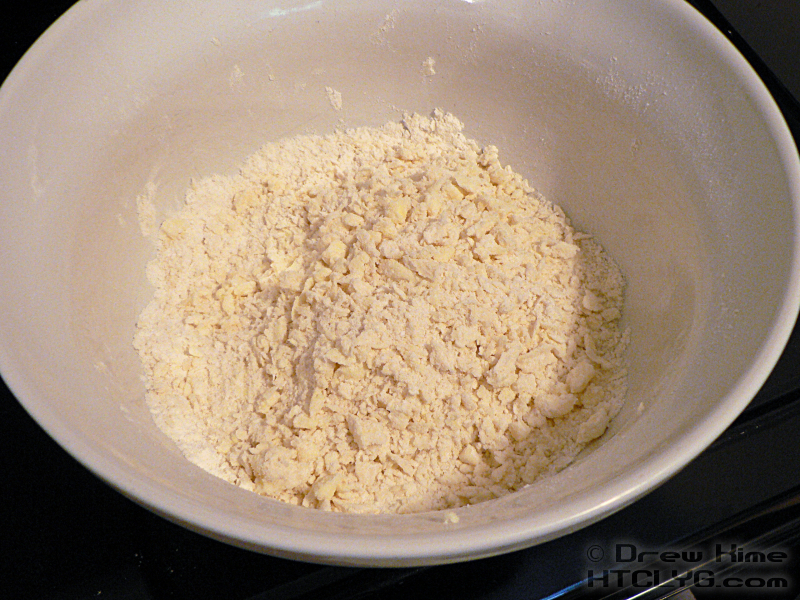
This next step is much easier if you have a .
If you don’t have a pastry cutter and want to get one, get the kind with blades like in the link above. Don’t get the wire kind that I used in the photo. Cold, hard butter pushes the wires to the side, and you want the butter to be cold and hard for this.
Don’t overwork it or let the butter get too warm. You should have little lumps of butter coated in flour and sugar. These bits of butter will flatten out when you roll it, leaving little pockets when cooked. This is what gives pastry its light, flaky texture. If the butter melts, you’ll end up with the consistency of al dente pasta.
Add the cold water and quickly form it into a dough. If the butter has gotten warm by this time, or if it’s especially warm in your kitchen, you might want to put the flour/butter mixture in the freezer for 10-15 minutes before adding the water and making the dough.
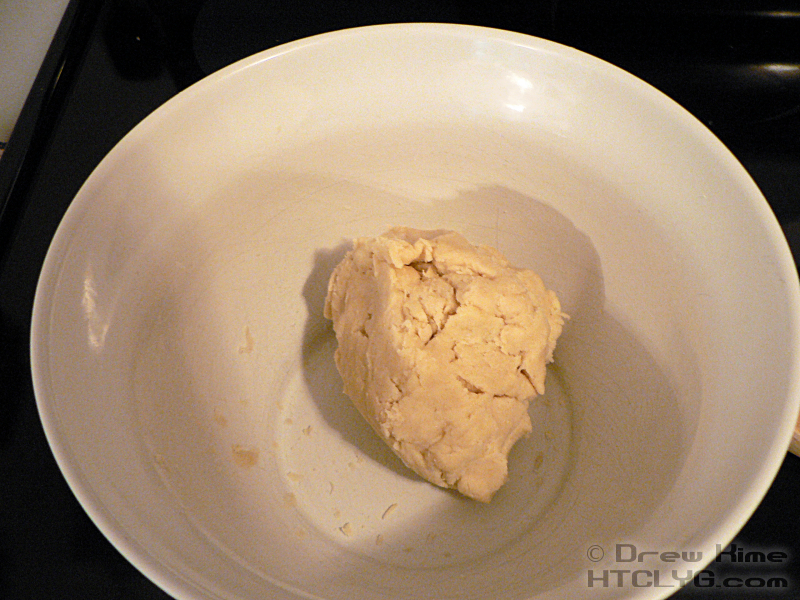
Once you’ve made the dough, transfer it to a one gallon zip-top bag and put in the refrigerator for at least a half-hour. You need this time for the water to soak into the flour. Otherwise it will just steam out when you bake it.
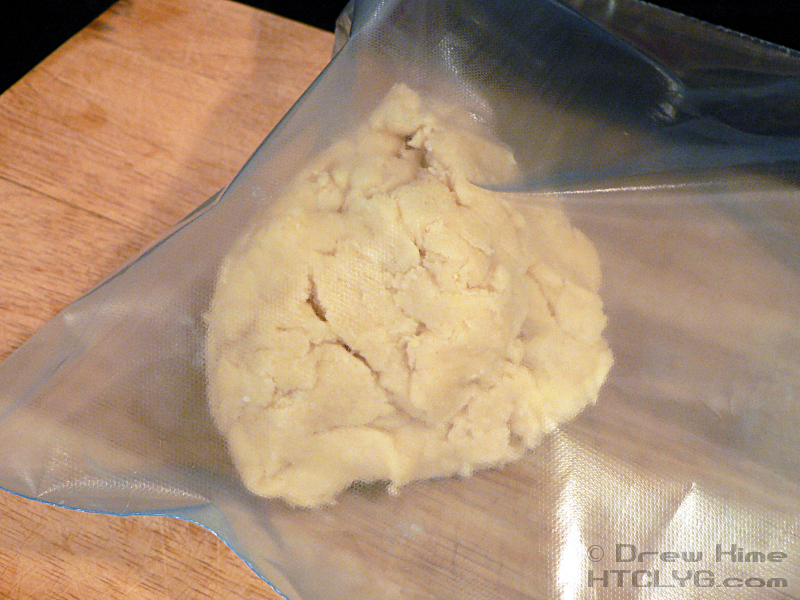
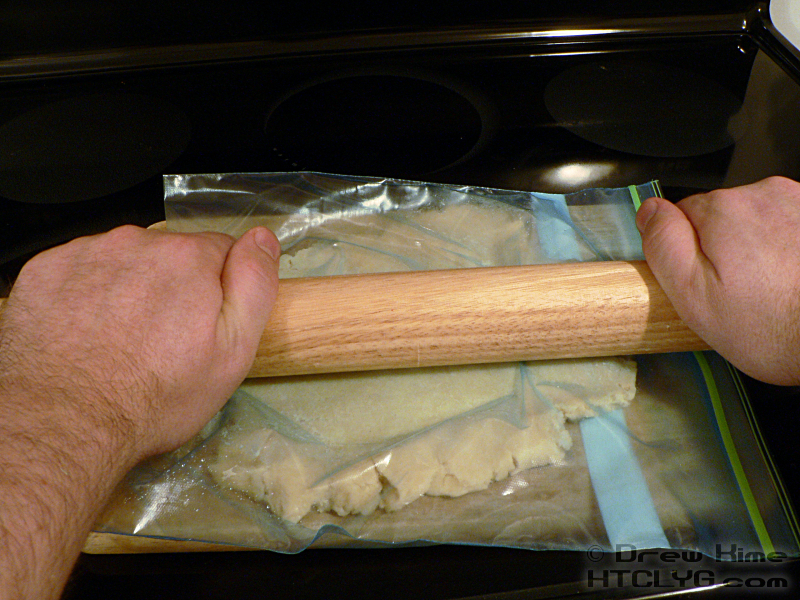
Take the dough out and roll it into a circle, still in the bag. Most one-gallon bags are just about nine inches across, which is exactly how big you want the crust to be. This also saves you from having to put flour on the table and rolling pin, and dealing with the cleanup afterwards.
After it’s rolled out, you can put it back in the refrigerator for two to three days, or freeze it and keep for several weeks.
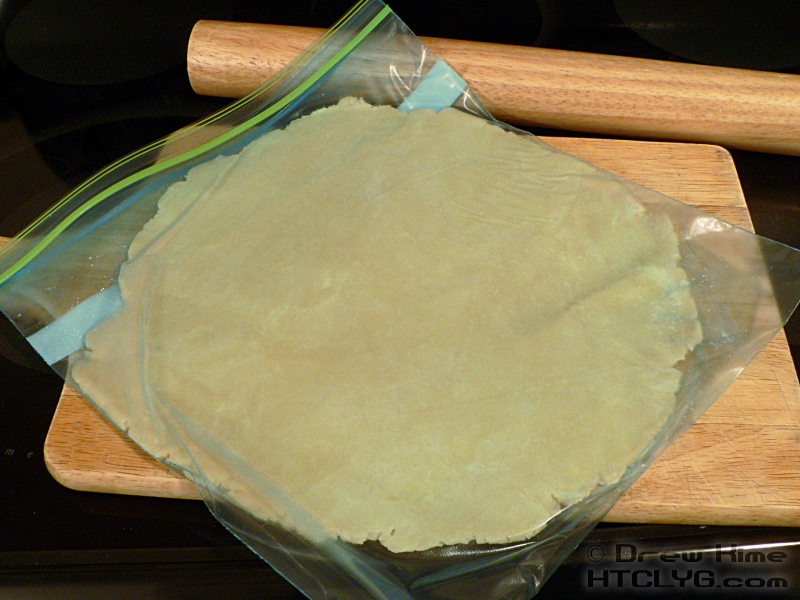
When you’re ready to use it, make sure the dough is nice and cold so it doesn’t stick to the bag. Rip the bag open along the seams and pull the crust out.
And that’s it.
One more day until you see what is made from pie crust and apples but isn’t (quite) apple pie. Subscribe via the link in the column to the right to make sure you don’t miss it. It’ll make a great finish to your Memorial Day cookout, I promise.


31 Comments
Drew,
Why do you use butter for your fat?
I find that lard gives a flakier crust.
This is a great blog.
Thanks, Frank
Excellent illustration. I’ve never made a pie crust but you make it look quite easy. I can’t wait to see your final pie crust and apple creation.
Frank, you’re right about the lard. I wasn’t able to make a trip to the West Side Market last week, and my local grocery store only had the fake lard that’s mostly hydrogenated vegetable oil. Next time.
Andy, you don’t know how nervous I was while doing it! My wife is the baker in the family, so I’ve always let her deal with the pie. It was a lot easier than I thought it would be.
I’m glad you’ve conquered your fears. Maybe I’ll follow your sterling example. Or not. I have never and will never make pie. Know why? Because my mother-in-law WON A PRIZE AT THE COUNTY FAIR for her apple pie, and who wants to compete with that? Plus, she lives with us and so can make all the pies we need. And she uses lard. That we render ourselves from the kidney fat of a pig we bought for slaughter last fall. Hard core, right? And yes, a little gross. But the pie crusts made with that lard sure are good.
Now come on, Kristin, you’ve got to post some pics of that. I’ve rendered my own tallow, but I haven’t done the lard yet. If my experience with the tallow was any indication, there will be at least one or two ways I can mess it up. I’d rather learn from your mistakes. (I don’t need any more burn scars on my forearms.)
Oh not to worry–we should be rendering some more lard soonish, as we are currently out, and I will definitely be posting about that. I like to gross people out with my blog posts sometimes. Last time my mother-in-law did it, she came upstairs to tell me that the fat was kind of pretty, all pink and white. And I thought at that moment that I will never be country enough to think a pig’s kidney fat is pretty.
I have a picture my daughter made me take of the turkey giblets as she was helping Nana make the stuffing. There was a fat glob that, from the right angle, looked like a little white poodle. I’ll see if I can find that one.
Thank you for suggesting that pastry blender. i had no idea there was one with blades instead of wire, and i would have bought the wrong kind.
I am having a big party in december and was planning to buy some big chicken pot pies for the crowd. last year i got them at Costco and they were not bad but way too salty. I was thinking of making my own this year and feeling a bit ‘out to sea’ regarding the chore of making four pies from scratch. Now i am feeling a bit more courageous. Any suggestions for a tasty inside for these chicken pot pies? thanks so much.
Carol, I’d go with the turkey soup recipe I did a while back, but with two changes. First, substitute cubes of potato for the noodles. Second, after cooking the thighs and removing them from the pan, add a couple of tablespoons of flour to the fat and stir over low heat to make a roux. (This means you have to get the thighs with the skin still on or you won’t get enough fat.
The roux should thicken everything up nicely.
Great article. And as long as you’ve renewed the discussion with your pastry cutter link, I’ll add a few things:
1) I agree that pastry cutter blades are much better than wire.
2) I always use butter instead of lard or Crisco, because the flavor and mouth-feel of the butter is superior. Lard-based pastry always makes my mouth feel grainy.
Cook’s Illustrated suggested 1/2 butter and 1/2 Crisco, something about making it easier to keep flaky while still having butter flavor, but butter’s best.
3) The more paranoid you are about handling the dough (because too much handling makes it tough), the better. Being too careful of this up front gives you leeway later when you mess it up and have to re-roll it.
4) I really, really like pie. It’s really the perfect food.
Thanks again for a great posting.
Mike, Crisco could give better mouth feel than … well, I shouldn’t use the line I’m thinking of, because this is a public place. But anyway … I still wouldn’t use it. That stuff is axle grease.
I still wouldn’t use it. That stuff is axle grease.
Agreed. I only mentioned it because Cook’s Illustrated did a bunch of testing and came up with their version of “perfect” pie dough that was part butter and part Crisco. I personally won’t use Crisco and stick to butter. So to speak.
I made this crust and it turned out very nicely. One question, if you ever get a chance, is how the heck to roll a round crust?
I’ll probably be showing this again soon. Basically, you want to form it into a ball and press down with your hands so it is flattened out some but still round.
Then work from the center out. Keep turning the crust a little at a time. This takes a little practice, but you can get pretty good at it after one or two tries.
Well, the pie was so good that my seven year old ate a chunk of it before I woke up this morning so I will get some practice rolling out a circular pie crust again today. It seems I need to slow down and not be so impatient. Thanks for the help, Drew, and have a happy Thanksgiving with your loved ones. You have a great food blog.
The pie that was supposed to be for today? Ooh, I’m sorry you had to kill your 7-year-old on Thanksgiving.
My Grandmother doesn’t have harry arms….
Mine did. But then she was Italian.
I thought this howto was great. It’s next to impossible to find a recipe that doesn’t require a food processor or electric mixer. Can’t wait to try out your other recipes.
I forgot to add that rolling the dough in the ziplock bag is a fantastic idea. Even Martha Stewart hasn’t thought of this one.
I don’t have anything against food processors. I just don’t have one.
Hey Drew. How about proper baking tips? I'm also curious about frying dough. Can you give tips on fried pies, etc..?,..
John, my wife is more of a baker than I am. A couple of my most popular posts were her. I'll tell her people are asking for more.
Your recipe was very quick and convenient i love love love the idea with using the ziplock bag..thank you…but for the top crust do i need to double recipe??
Yes, this just makes a single crust. You'd have to do another batch for a top crust.
And by the way, I wouldn't try to just double the recipe and split it in half. Way too hard to divide it evenly, in my opinion.
I can't wait to try this. Does it really make a difference if I sift the flour and sugar and salt?
Ally, the important thing is to make sure the sugar and salt are very evenly distributed throughout the flour. Sifting does that, and also makes sure there are no lumps in the flour.
To make the BEST pie crust ever, use cold whole milk instead of water. Old family secret (thanks mum) and for the past 20 years my requested contribution to the family holiday dinners are the pies!
Elizabeth, I’ll definitely try that next time. Thanks.
I’m definately going to try this crust recipe. Can you also advise us how to cook the crust in the oven when using fresh apple slices? My crust always falls down around the edges and sides and the bottom of the pie crust is raw and too moist.
Carol, two things you can try. First, make sure you roll it out a good inch-and-a-half to two inches larger than your pie plate. Then crimp it down on top of the rim, maybe even a little bit over the edge.
If that doesn’t work, you could try pre-baking it a little bit until the top crust is set before adding the filling. You can see in this version of pre-baked pie crust that I didn’t crimp it as well as I should have on the top edge. But with the coins I filled it with holding it in place (you can also use rice or pie weights — yes, they make little weights just for this) it only slipped down a little way and then stopped.