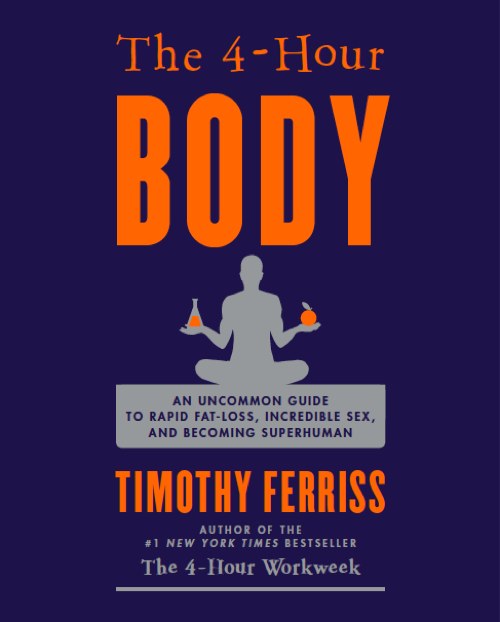
Back in the summer of 2007 I was in a rut. Work was just a job, and at night I’d watch TV or spend time online in various internet forums. Then I stumbled across the book The 4-Hour Workweek.
If you haven’t heard of it, it’s about “lifestyle design”. Most people see it as a manual for starting an online business. What I took from it was the idea that your time is a more important measure of independence than money. And I realized that all the time I spent online wasn’t building any equity. If I took all the posts I’d made to various forums over a year, I probably had enough material for a book. So I decided to write one. That was the start of How To Cook Like Your Grandmother.
The author of 4HWW, Tim Ferris, now has come out with a book about bodystyle design (Did I just coin that phrase? I think I might have.) — The 4-Hour Body I don’t know yet if it’s going to have the same effect on me as the first one, but so far it looks promising.
Choose your own adventure
Just like Ferris’ last book, there’s way more information in 4HB than you can use at one time. But this time he provides a roadmap for four different ways you can read it. You can read the eight chapters about weight loss; eight chapters on muscle gain; seven chapters on strength gain; or twelve chapters on sense of total well-being, which includes improving sex and sleep.
Of course I started with … weight loss. (What did you think I was going to say?) And pretty much everything he says lines up with what I’ve been reading for the past couple of years. The short version is that most of the conventional wisdom is wrong:
- It’s not just about calories in vs. calories out.
- Eating fat doesn’t make you fat, eating carbs makes you fat.
- Working out will build your muscles, but won’t eliminate fat.
Science isn’t just for scientists
Ferris gets into lots of detail about the why behind each of his recommendations. Clocking in at more than 500 pages, he went into lots of detail on lots of things. But more importantly, he’s actually tested everything in the book … on himself. Sure, that means he has a sample size of one, but everything he tried is based on the work of experts in various fields: bodybuilders, powerlifters, Olympians, trainers, dietitians and PhD’s.
The scientific method is about experimentation. Whether you support their activities or not, you have to admit bodybuilders (for instance) are willing to conduct experiments on muscular development and weight loss.
That doesn’t mean Ferris is saying you should take steroids, or even supplements. In fact, the basic weight loss diet doesn’t call for any supplements. If you want to go from 15% body fat to 8% though … yeah, you’ll need something more than diet and exercise.
So does it work?
I don’t know if it will work on me yet. I’ll be trying it out starting next month. There’s no way I’m starting a new diet before the holidays. Stay tuned.
Want more like this? For more recipes like this, that you can hold right in your hands, and write on, take notes, tear pages out if you want (Gosh, you're tough on books, aren't you?) you might be interested in How To Cook Like Your Grandmother, 2nd edition, Illustrated. Or to learn your way around the kitchen, check out Starting From Scratch: The Owner's Manual for Your Kitchen.


8 Comments
Or you could just follow A.’s diet plan, on which he lost about 20 pounds: eat meat. LOTS OF MEAT.
He was actually sort of following the Paleolithic diet (yes, it’s an actual thing), except that’s a little extreme. Plus, when you’re eating pretty much nothing but meat and some vegetables, you have to eat A LOT of meat. Which I got really tired of cooking. Thankfully, he’s moderated this now and eats more like a reasonable person. Though he’s still a little much with the meat consumption. Worked for him, though.
That’s actually pretty close to what’s in 4HB, except that he recommends lots of legumes to make up for the calories lost from giving up carbs. So for instance instead of meat, rice and veggies you’d eat meat, lentils and veggies.
Once we start on it in January, I’ll be posting some of the recipes we do and talking about the details of it more, but you could really get most of the way there with two rules: don’t eat fruit (lots of sugar), and replace all your white carbs with legumes instead. That’s about it.
I’m looking forward to reading the 4HB! Though, I not expecting it to be easy to get great results…hopefully there will be some cool hacks to do things in a more efficient way.
http://sethigherstandards.com/2010/12/15/the-truth-about-a-4-hour-body/
I started this the day I heard about the book. And someone posted on my blog about your blog, so that’s how I ended up here.
I’m a TOTAL foodie (and I love my grandmother’s cooking). I think you’ll definitely lose weight on it. It’ll probably also challenge your cooking (well, the baking), so I’m really looking forward to see some of the things you end up posting here as a result of your slow-carb experiences.
Good luck! There is a lot of 4HB support out there for when you need it. Thanks for posting the review!
-j
Jason, I do most of my cooking for the blog on the weekends, so I don’t expect things to change much around here. If anything, you’ll be less likely to find slow-carb recipes, since I’ll be mostly showing my cheat days.
Hmm … might want to thing about that some more.
Why are you trying to lose weight? Is it because it’s the trendy thing to do?
Why does the author assume his readers want or need to lose weight? What about those of us who are underweight? Does he address how to gain weight safely and effectively? Why isn’t the point health and fitness instead of weight?
Trendy? People have been trying to lose weight for about forever. Losing weight has been a multi-billion dollar industry for decades. And I’m doing it because I’m overweight.
As for the book, he doesn’t assume you want or need to lose weight. There are four main tracks, and two of them are gaining muscle and gaining strength.
And even if you are interested in losing weight, the emphasis is on health and fitness. He specifically addresses the fact that becoming more fit will generally mean increasing muscle mass, so weight could go up even while your waist size (and other measurements) is going down.
My wife and I started the 4-Hour Body diet a week ago and I already lost 9 pounds!
The best part is, we are eating stuff like this for breakfast:
Spinach-Mushroom Omelette
- 4 eggs
- ½ cup mushrooms, sliced
- ¼ cup bell pepper (preferably mix of green and red), chopped
- 2 tablespoons onion, chopped
- 1 tablespoon macadamia oil
- 1 cup spinach, loosely chopped
- 1 clove garlic, minced
- 1 teaspoon red pepper flakes
- ¼ teaspoon salt
- ¼ teaspoon pepper
You can find more slow carb recipes at http://www.4HourRecipes.com.