For special deals and more great content, sign up for the free How To Cook Like Your Grandmother Newsletter.
Email address:


Also receive blog posts via email

Name: (optional)

Not now, thanks

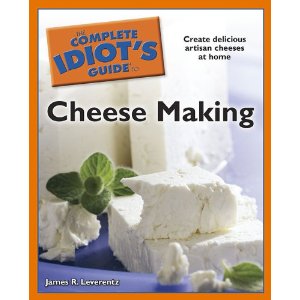
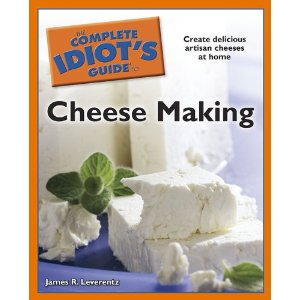
Review: The Complete Idiot’s Guide to Cheese Making

You don’t have to be a complete idiot to need help making cheese. But it helps. (Ba-dump-tish … thank you, I’ll be here all week.)

Seriously though, cheese making isn’t something most of us learned growing up. Frankly, I wonder if this was ever a common skill, or if there were always people who specialized in it. How about it, any food anthropologists out there got some insight?

What I do know is that when I was growing up cheese meant one of four things: white American slices we got at the deli for our sandwiches — including our grilled cheese; Velveeta, which was a special treat — especially when you used it for grilled cheese; Parmesan in the green can for spaghetti; or port wine cheese in a plastic tub that we’d get around the Christmas holidays each year and spread on Ritz crackers.

It never occurred to me to try making my own cheese. In fairness, it never occurred to me to try making my own bread, or ice cream, or barbecue sauce either.

Now, though — now that I know more about the junk that goes into so much processed food — the idea of making my own cheese is pretty cool. The Complete Idiot’s Guide to Cheese Making is the perfect starter.

I know some people can’t get past the name of the books in this series, but it’s catchier than the more accurate “The Cheese Making Guide for People Who Can Follow Clear Directions but Don’t Know Anything About the Subject and Need Very Explicit Directions”.

Basic … no, I mean basic

It was really interesting to read something written the way I try to do my recipes: Not assuming any special knowledge and spelling it all out. There were times while reading it that I thought, “Come on guys, isn’t that a bit simplistic?” But for every time I caught myself thinking that, there were pages and pages of answers to basic questions I didn’t even know to ask.

How basic? Things like the different kinds of milk: skim, whole, cream, raw, pasteurized and ultra-pasteurized, goat or buffalo milk. Categories and classifications of cheese: specialty, artisan, farmstead, fresh, semi-soft, soft-ripened, hard, blue, pasta filata, natural and washed rind, processed.

You’re four chapters in before you see the first recipe. And there’s a warning in the introduction to not try to skip the early chapters and jump right in. Take it seriously. By the time you get to the recipes, the writing assumes you’ve already read and understood everything that leads up to it.

Not for everyone

There’s a pretty good chance this book isn’t for you. If you’re anywhere near a good-sized city you can find cheese shops with plenty of good cheeses to choose from. They may be more expensive than what’s at the deli counter in the grocery store, but you’ll save a bunch of time and (possibly) frustration.

But if you do want to try making your own cheese — for health reasons, or as a hobby, or because you’ve got a good supply of raw milk and can’t drink it all* — then The Complete Idiot’s Guide to Cheese Making will show you everything you need to get started.

* If you’ve got more raw milk than you can drink, and you live anywhere near Cleveland, OH, let me know. I can take some of it off your hands.
Want more like this? For more recipes like this, that you can hold right in your hands, and write on, take notes, tear pages out if you want (Gosh, you're tough on books, aren't you?) you might be interested in How To Cook Like Your Grandmother, 2nd edition, Illustrated. Or to learn your way around the kitchen, check out Starting From Scratch: The Owner's Manual for Your Kitchen.

This entry was posted in Dairy, Review. Bookmark the permalink. Post a comment or leave a trackback: Trackback URL.

12 Comments

  1. Posted July 26, 2010 at 5:56 pm | Permalink

    I’m not a food anthropologist, but I’m an anthropologist who focuses on food… does that work? :)

    The classic story about how cheese was discovered was that someone was carrying milk in a skin made from a calf’s stomach, and the rennet in it turned the beverage into something delicious. But… rennet isn’t remotely the only way to curdle milk into cheese, so I have my doubts. I mean, when I was 7 I made breakfast for the family and thought that mixing apple juice and milk would yield a nectarious beverage. It didn’t: it was sweet, curdled, apple-y curds and whey that my dad was kind enough to drink to the dregs before I tasted mine and warned the rest of the family. (He doesn’t even like buttermilk. I will remember that act of courage to my dying day.)

    I made a few batches of paneer before I figured out that I could buy Mexican panela cheese and it worked as well in my recipes and I didn’t have to figure out something to do with the whey afterwards. That experience really benefited me when I lived in Peru and wanted to eat some tofu — I just used my meager cheesemaking knowledge to make soymilk cheese (tofu!) and it was AWESOME and I was so empowered and felt very pioneer.

    In Peru, where I did my field work, many women make and sell simple white cheese as a cottage industry (along with brewing and all the other wonderful gray-market stuff I was there to study). Some cities are famous for their cheeses (which are all woefully homogenous — and underwhelming — to the globetrotting traveler): however, I never saw a specialist of any kind involved. Those who sold cheese in the market fairs (ferias) generally sold other products (sometimes dairy, sometimes not) as well. Those who sold cheese in the permanent markets usually did so as a sideline to vegetable or meat sales. (I learned early on not to buy perishable goods in “supermarkets” — it’s not worthwhile!) Bakeries were an exception: some of them made their own cheese on-premises to be spread on their breads (and some bought from women dabbling in cheesemaking).

    • Posted July 26, 2010 at 9:56 pm | Permalink

      I love the internet! I asked, you answered. This is awesome.

      One thing about whether they were “specialists”. You’re looking at it from the other direction than what I meant. You said they’re not specialists because they did other things, too. What I meant was does everyone do their own, or are there some people who do it for the whole community?

      From what you’re saying, there are lots of women who do it, but it does sound like it’s not something most people do for themselves.

      It’s funny what you said about finding something to do with the whey. I’ve thought the same thing about the buttermilk left after making butter. I hate to just dump it down the drain, but I really don’t need it for anything.

      • Posted July 27, 2010 at 2:00 pm | Permalink

        Drew, if you use the whey or buttermilk for baking liquid (ESPECIALLY quick breads like scones or cornbread), you will be rewarded. Delicious! It’s just the mad quantity of whey that is troublesome. I’ve tried adding it to stews and things for the mineral content, but bread is my favorite use.

        You’re so right — it is something that only some people seem to do — at least in Peru. I misunderstood you because I was thinking about it upside-down, from the perspective of the cheese-makers. They generally do so much else… honestly, the workday in Peru for the women I studied is astonishing. Up at 5 to cook breakfast from scratch for the kids, to prepare any perishable products, to do advance preparation for lunch (any slaughtering, marinating, cooking beans, etc.), and to do laundry, which must hang dry during the daytime; opening a market stall by 7 or 8 a.m.; preparing lunch for the family and cleaning up (not really much of a siesta!); back to work until closing time (never earlier than 7 p.m.); fixing dinner for the family; cleaning up; out to walk every evening, or if a there’s something going on, to go to a party or concert; home at… never earlier than 11 p.m., and often as late as 1 a.m. Add to that their normal chores, feeding domestic animals and tending any garden, maintaining their children and households, spending time with their hubbys, and producing artisan products like candies, tamales and humitas, empanadas, or fresh cheese, and… well, I have no idea when Peruvian marketers sleep.

        For what it’s worth, I think in India that cheesemaking is much more commonly done by everyday cooks, but I am not certain. But fresh paneer cheese is the simplest of the simple, and sooo rewarding.

      • Posted July 27, 2010 at 6:23 pm | Permalink

        Wow, that’s crazy. When you got to “open a market stall” I thought you were already up to about noon.

      • Posted July 28, 2010 at 12:05 pm | Permalink

        Particularly knowing that in my city, water ran for 2 hours every other day and had to be gathered in bins and cisterns — and laundry is a done-by-hand affair. There are no frozen foods, canned goods are regarded with horror and distrust, and packaged foods (like crackers and candy), although ubiquitous, are out of financial reach for many families. That all made MY days long and effortful! But then, I was doing an archaeologist’s laundry and my own… and archaeology socks are GRIMY.

      • Posted July 28, 2010 at 2:29 pm | Permalink

        “Archeology socks” … I’m going to start using that phrase. I’m not sure exactly how, but I’ll think of something.

  2. Posted July 27, 2010 at 2:08 pm | Permalink

    Well I have no cheese making skills whatsoever, but apparently it runs in my blood. My cousins have spent the past decade switching the family dairy farm to a farmstead cheese making facility (excuse me, award winning farmstead cheese!). I’ve seen recipes for cottage cheese, but was too afraid to try. But then I was also afraid to grow a veggie garden and cook okra, and they’ve turned out well.

    • Posted July 28, 2010 at 12:08 pm | Permalink

      I’ve made homemade cottage cheese exactly once, and it was sooooo worth it. A mess, and it made only a small bit, but it was delectable. And okra? YUM! Is it what you’re growing?

  3. Posted August 3, 2010 at 11:44 am | Permalink

    Shhhh: don’t tell my mother; I ordered this book for her for Christmas. Whether she makes cheese or not, she’ll enjoy reading it and imagining it. If she’s afraid of smelling up her apartment, I plan to invite her to my house where we’ll do it together.

  4. redbeccaz
    Posted August 9, 2010 at 2:04 pm | Permalink

    I got the cheesemaking bug earlier this year. It’s very time consuming to actually make the cheese and then in most cases you have to age it (sometimes for months) before you can even appreciate your efforts. But it is so very worth it. Even though I’ve had several failures it was enjoyable going through the process.

    The whey can be used to produce ricotta cheese although I’ve never had very good results. I water my veggie garden with it, dump it on the compost pile, cook grains like rice or oatmeal, use in place of water to make breads and soups. It can even be used to bathe in (think milk bath). You can also use whey in place of vinegar when pickling vegetables.

  5. Posted August 10, 2010 at 3:01 pm | Permalink

    I’ve heard from lots of people who say the hardest part is figuring out what to do with the whey. We know it’s useful, and just can’t stand to throw it out, but don’t really need it for anything.

  6. Posted September 13, 2010 at 8:04 pm | Permalink

    You can also feed whey to pets (animals love it and it is high in protein) and use it to soak legumes and grains a la Nourishing Traditions. You can use it to make beet kvass or cabbage rejuvelac and even water houseplants. Like buttermilk and sour cream it will make your baked goods rise to new heights and taste delicious.

Subscribe to comments on this post

Post a Comment

Your email is never published nor shared. Required fields are marked *

*
*

You may use these HTML tags and attributes: <a href="" title=""> <abbr title=""> <acronym title=""> <b> <blockquote cite=""> <cite> <code> <del datetime=""> <em> <i> <q cite=""> <strike> <strong>

Subscribe to comments on this post
  • Follow this blog

     Subscribe in a reader

    -- OR --
    To get recipes in your email
    Enter your email address:
    -- OR --
    Sign up for the weekly newsletter.Email address:
  • All-time Favorites

    Perfect Brownies
    Banana Cake
    French Onion Soup
    Egg Salad
    Onion Rings
    Bruschetta Pizza
    Peach Cobbler
    Cheesesteak
    Frozen Chocolate Truffle Pie
    Emily's Creamy Cheesecake


  • What Would Granny Cook?
  • No Secret Recipes
  • No Awards Please