
I’ve read a lot of really old cookbooks. And when I say “old” I mean back to medieval English. But I have never seen anything quite like this little gem. I haven’t read the whole thing yet, so I’m holding out hope there’s something even more amazing. But I had to share the first few things I found.
I came across this earlier this summer while I was on vacation and thought, “Wow, great. I’ll get some great stuff out of this.” Yeah, umm … not so much. Okay, let me back up and walk you through my thought process.
Look at the cover. This was clearly printed a while ago. Let’s take a look inside.
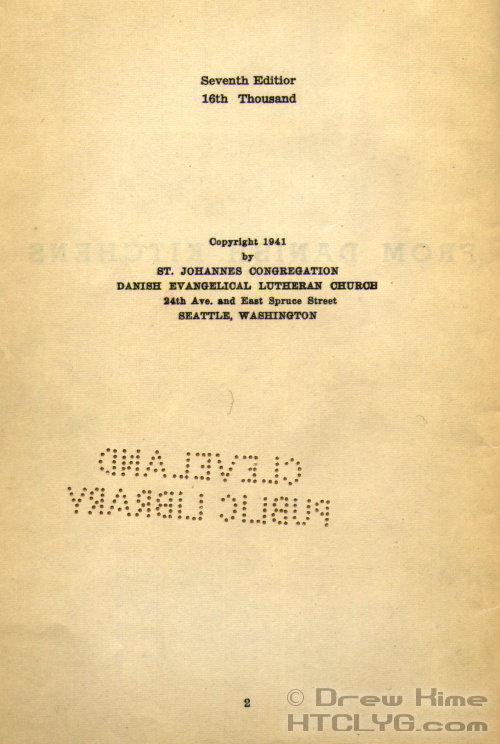
Awesome. Ethnic churches in mid-20th century Cleveland tended to have high concentrations of first generation immigrants. I assume Seattle was similar, so these were going to be authentic recipes.
And by the way, don’t you love the way the library punched the page? Yes, that’s punched all the way through, like the tickets in The Polar Express. You’re not crossing that out.
Hey, let’s see if it’s still got the due-date in the back.
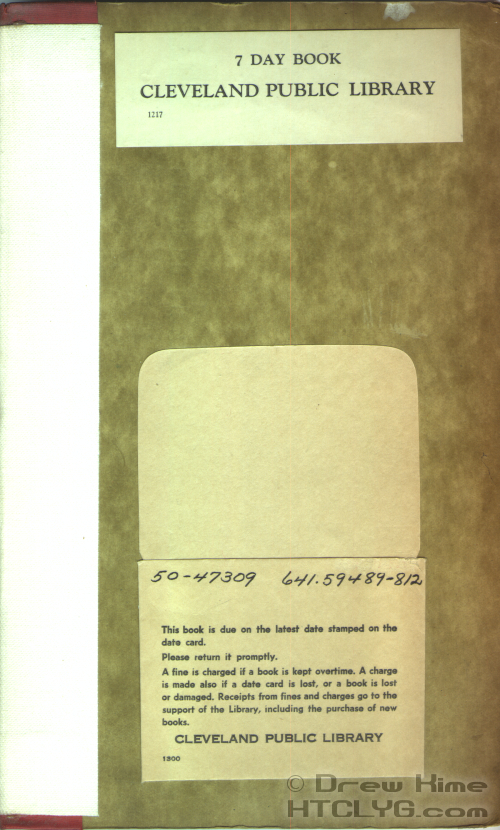
Darnit, the card is missing. Oh well. I wonder what the fine is up to.
So on to the recipes. How about the cookies, everyone likes cookies.
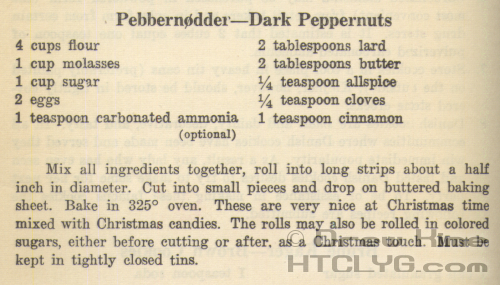
Yeah, okay, that sounds pretty good. No, wait … hold on a second. What does that say at the bottom of the first column?
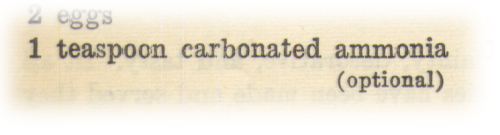
What the hell?! Is that for real? That’s not even food, what are they doing putting that in cookies? And can you even get carbonated ammonia today? Would that be in the grocery store or the hardware store?
UPDATE: I’ve had several people tell me that ammonium carbonate is a powder similar to baking soda. There are still people who prefer it for cookies, though it does not work for cakes or bread.I got an email from a Mennonite — yeah, I was surprised, too — who said she gets it at the pharmacy. And warned not to get it too close to your nose, as the smell is very potent. I’ll keep that in mind.
So maybe I won’t be making the cookies. Let’s try the soups.
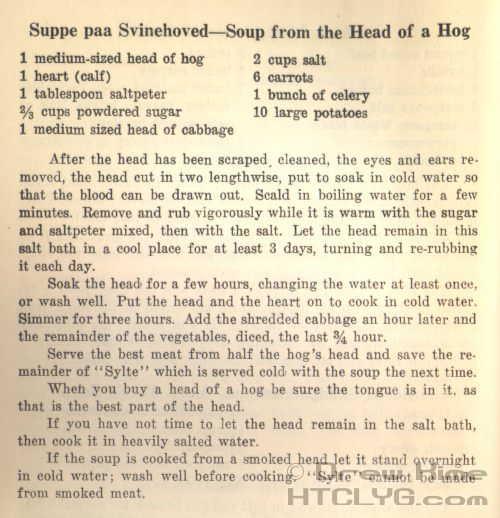
Oh you’ve got to be kidding me. I know this is a cultural thing, and there are places where they love cooking the hogs head. (And every other piece of the pig.) But this …

… that’s just gross.
So now that I’m pretty sure I won’t be cooking anything from this book (Eww!) maybe the “Remedies” section at the end will have something good.
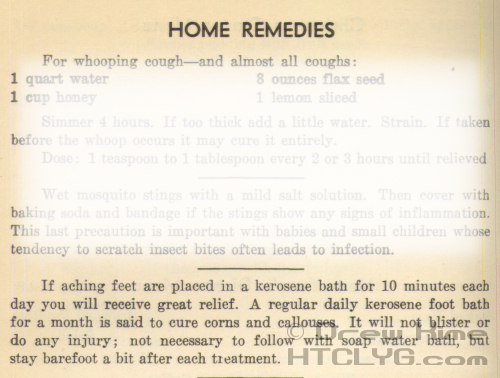
After what I saw in the recipes, I thought I was prepared for the remedies to be odd. But give me a break. Soak your feet in kerosene?
If this is authentic Danish cooking, you can have it.





18 Comments
haha. where did you get that thing?
Tongue is very traditional food in many cultures, and when well prepared tastes lovely. Why is eating a tongue any more or less gross than eating an animal’s inner thigh?
It’s certainly a traditional English dish, though it is dying out in most places (apart from in restaurants such as St John’s), but it’s a common theme worldwide: my local yakitori bar does a lovely gyu tan (ox tongue) yakitori.
Try cooking like your Danish grandmother and see if it tastes nice…
You’re such a wuss, Drew. A real man would scrape those hog bristles.
My grandmother has scraped many a hog’s head to make headcheese in her day. She says she wouldn’t eat it, though.
Meanwhile, try here for the baker’s ammonia, aka Hartshorn. You’ll never bake a lighter, crisper cookie than you will with this stuff.
LOL, I’m dying with laughter here. I agree, I do not want to cook like your Danish Grandmother!!! Mine will work just fine thank you very much!
Reminds me very much of my great-aunt’s hand-written recipes in her ledger that I’ve inherited. I’ve been trying to scan it and print it into a cookbook for all of my cousins. Includes recipes for cured hams and cold-processed lye soap after hog-killing season.
Cupcake (can I call you by your first name?) it was in the back of the top cupboard in the condo we rented for our vacation on Kelley’s Island. The owner lives a couple of miles away from me here in Cleveland — Euclid actually, if you’re local enough to know where that is. She has lived in Cleveland long enough that I suspect she’s the one who took it out of the library.
Geoff, I know I’m a product of my culture, but the idea of tongue just grosses me out. Any part that is recognizably part of the head, actually. I don’t even like fish cooked with the head on. I’ll happily snap the head off, cook the rest and eat it. But I can’t have my food watching me.
Yes, Kristin, I am.
Kerry, I’m no good at that. I can’t make things for other people that I don’t like. How would I know when it’s right? As for the ammonia, I suspected it was an earlier name for baking soda, or something like it. We don’t seem to like product names that make it too clear we’re doing a chemistry project for dinner.
Honeyb, thank you for agreeing. I knew I’d get a few people telling me they’d eat this stuff, but everyone?
Trixie, have you seen Recovered Recipes? Take a look.
Baker’s ammonia was originally ground reindeer’s horn – and is the predecessor of baking powder.
It’s useful in things like cookies since it imparts a crispness and the ammonia bakes away. (I imagine using it in cakes probably wouldn’t work too well).
A propos of nothing, the book was published by a Seattle church, not in Cleveland. 24th and E Spruce is actually just a couple blocks north of my boyfriend’s house.
I guess my point is to give credit where credit is due: Seattle’s Danes are responsible for that hog’s head recipe!
Tzard, I guess that’s why it was also called Hartshorn.
And you’re right, anon, it was Seattle. I saw what library it was from and made an assumption. Got to go back and fix that.
Okay, that is just scary funny. I love the soup recipe with the hog head. Wow (as in, wow that is really yucky).
Hey Drew, I’m glad you love the “older” books too. There’s a wealth of information found in them that seems to be missing in todays editions. I found a reproduction of a 1898 El Paso (Texas) Ladies Auxiliary Cookbook. I love it. It’s truly authentic. Wish I had the real thing.
Hey, Drew…. About those dark peppernuts… My Oma(great grandmother) used to make peppernuts at Christmas time…. Quite a tradition in our family… The ingredients are similar to the Danish recipe except for the ammonia… she used baking soda. Don’t we live in a wonderful world now of modern conveniences. I almost had a coronary having to pluck dead chickens in my youth. Thank God for butchers….
Stephanie, I refrained from linking to the picture of the process. Which I have, because a friend of mine actually cooks like this.
Teresa, I’m interested in authentic recipes. I don’t care about the books themselves. I’m not a collector at all.
Beth Ann, I don’t plan on doing any plucking. When I find a local source for fresh chickens — and I’ve got an address for one I need to visit — I’ll gladly pay the extra buck or two to have it plucked.
Drew, when you get them to pluck, make sure they “dress” as well. The smell alone of singing feathers and guts is one of the reasons I’m not a big poultry fan, either! LOL
If you want my Oma’s peppernut recipe, give me a shout. They sure do bring back some fond Christmas memories for me.
For what it’s worth we are German. Papa ate some wierd stuff that my Father wouldn’t even comment on! LOL
Oh, absolutely send the recipe. I love authentic (ie: strange) old recipes. I won’t promise to make everything I get, but I’m trying to be more open-minded.
I just found you through Alison’s BrocanteHome blog and I love your site! On the Kerosene remedy, my Grandmother used to take a teaspoon (as in drink the stuff) whenever she started coming down with a cold. She was one tough old bird.
Now that’s just gross.
But I’ll bet she never got sick, did she?